Cooling air ring optimization
The cooling air ring is the primary heat exchanger that quenches the molten bubble and determines its stability and final film properties. Optimization involves adjusting airflow volume, velocity distribution, and temperature. The air ring delivers high-velocity air through a circular slot or multiple nozzles; the flow must be perfectly symmetrical around the circumference. Even a 5% imbalance causes bubble oscillation and thickness rings. Use a manometer or anemometer to measure air velocity at multiple points; shim or adjust baffles to equalize. The total airflow, controlled by blower speed or damper position, affects cooling rate: higher flow lowers the frost line (faster cooling) and increases output but may cause chill haze; lower flow raises frost line, improving clarity but reducing output. Find the optimal balance for each resin. The air ring height relative to the die lip also matters; typically 50–200 mm. For dual-lip air rings, the lower lip provides primary cooling and the upper lip stabilizes the bubble; adjust their ratio (e.g., 60/40) for best stability. The air temperature can be controlled by using chilled air (10–20°C) to boost output by 20–30%, but avoid condensation on the bubble. Regular cleaning of the air ring slots and internal passages is mandatory to prevent flow distortion. Also, inspect for damage or warping. Modern air rings have segmented lips with individual adjustments to correct thickness profile. Operators should create a baseline airflow setting for each product and monitor bubble diameter and frost line stability. Optimization reduces gauge variation, improves optical properties, and increases line speed. Document all air ring settings and changes.
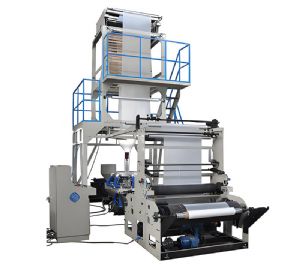
Blown Film Machine
The cooling air ring is the primary heat exchanger that quenches the molten bubble and determines its stability and final film properties. Optimization involves adjusting airflow volume, velocity distribution, and temperature. The air ring delivers high-velocity air through a circular slot or multiple nozzles; the flow must be perfectly symmetrical around the circumference. Even a 5% imbalance causes bubble oscillation and thickness rings. Use a manometer or anemometer to measure air velocity at multiple points; shim or adjust baffles to equalize. The total airflow, controlled by blower speed or damper position, affects cooling rate: higher flow lowers the frost line (faster cooling) and increases output but may cause chill haze; lower flow raises frost line, improving clarity but reducing output. Find the optimal balance for each resin. The air ring height relative to the die lip also matters; typically 50–200 mm. For dual-lip air rings, the lower lip provides primary cooling and the upper lip stabilizes the bubble; adjust their ratio (e.g., 60/40) for best stability. The air temperature can be controlled by using chilled air (10–20°C) to boost output by 20–30%, but avoid condensation on the bubble. Regular cleaning of the air ring slots and internal passages is mandatory to prevent flow distortion. Also, inspect for damage or warping. Modern air rings have segmented lips with individual adjustments to correct thickness profile. Operators should create a baseline airflow setting for each product and monitor bubble diameter and frost line stability. Optimization reduces gauge variation, improves optical properties, and increases line speed. Document all air ring settings and changes.
Оптимизация охлаждающего воздушного кольца: Охлаждающее воздушное кольцо является основным теплообменником, который закаляет расплавленный пузырь и определяет его стабильность и конечные свойства плёнки. Оптимизация включает регулировку объёма потока воздуха, распределения скорости и температуры. Воздушное кольцо подаёт высокоскоростной воздух через кольцевую щель или несколько сопел; поток должен быть идеально симметричным по окружности. Даже 5% дисбаланс вызывает колебания пузыря и кольцевые перепады толщины. Используйте манометр или анемометр для измерения скорости воздуха в нескольких точках; регулируйте прокладками или дефлекторами для выравнивания. Общий поток воздуха, регулируемый скоростью вентилятора или положением заслонки, влияет на скорость охлаждения: более высокий поток опускает линию инея (более быстрое охлаждение) и повышает производительность, но может вызвать холодную мутность; более низкий поток поднимает линию инея, улучшая прозрачность, но снижая производительность. Найдите оптимальный баланс для каждой смолы. Высота воздушного кольца относительно кромки головки также важна; обычно 50–200 мм. Для двухгубных колец нижняя губа обеспечивает первичное охлаждение, а верхняя стабилизирует пузырь; регулируйте их соотношение (например, 60/40) для наилучшей стабильности. Температура воздуха может регулироваться с помощью охлаждённого воздуха (10–20°C) для увеличения производительности на 20–30%, но избегайте конденсации на пузыре. Регулярная очистка щелей и внутренних каналов воздушного кольца обязательна для предотвращения искажения потока. Также проверяйте на повреждения или деформацию. Современные кольца имеют сегментированные губы с индивидуальной регулировкой для коррекции профиля толщины. Операторы должны создать базовые настройки потока для каждого продукта и контролировать диаметр пузыря и стабильность линии инея. Оптимизация снижает разброс толщины, улучшает оптические свойства и увеличивает скорость линии. Документируйте все настройки и изменения воздушного кольца.
Otimização do anel de ar de resfriamento: O anel de ar de resfriamento é o principal trocador de calor que resfria a bolha fundida e determina sua estabilidade e as propriedades finais do filme. A otimização envolve o ajuste do volume do fluxo de ar, da distribuição da velocidade e da temperatura. O anel de ar fornece ar em alta velocidade através de uma fenda circular ou múltiplos bicos; o fluxo deve ser perfeitamente simétrico em torno da circunferência. Mesmo um desequilíbrio de 5% causa oscilação da bolha e anéis de espessura. Use um manômetro ou anemômetro para medir a velocidade do ar em vários pontos; calce ou ajuste defletores para equalizar. O fluxo de ar total, controlado pela velocidade do soprador ou posição do damper, afeta a taxa de resfriamento: fluxo mais alto abaixa a linha de geada (resfriamento mais rápido) e aumenta a produção, mas pode causar névoa por resfriamento; fluxo mais baixo eleva a linha de geada, melhorando a transparência, mas reduzindo a produção. Encontre o equilíbrio ideal para cada resina. A altura do anel de ar em relação ao lábio da matriz também é importante; tipicamente 50–200 mm. Para anéis de ar de lábio duplo, o lábio inferior fornece o resfriamento primário e o lábio superior estabiliza a bolha; ajuste sua proporção (ex.: 60/40) para melhor estabilidade. A temperatura do ar pode ser controlada usando ar resfriado (10–20°C) para aumentar a produção em 20–30%, mas evite condensação na bolha. A limpeza regular das fendas e passagens internas do anel de ar é obrigatória para evitar distorção do fluxo. Inspecione também quanto a danos ou empenamento. Anéis de ar modernos têm lábios segmentados com ajustes individuais para corrigir o perfil de espessura. Os operadores devem criar uma configuração de fluxo de ar de base para cada produto e monitorar o diâmetro da bolha e a estabilidade da linha de geada. A otimização reduz a variação de espessura, melhora as propriedades ópticas e aumenta a velocidade da linha. Documente todas as configurações e alterações do anel de ar.
Jäähdytysilmakehän optimointi: Jäähdytysilmakehä on ensisijainen lämmönvaihdin, joka sammuttaa sulan kuplan ja määrää sen vakauden ja lopulliset kalvon ominaisuudet. Optimointi sisältää ilmavirran määrän, nopeusjakauman ja lämpötilan säätämisen. Ilmakehä tuottaa suurnopeuksista ilmaa pyöreän raon tai useiden suuttimien kautta; virtauksen on oltava täysin symmetrinen kehän ympäri. Jopa 5 %:n epätasapaino aiheuttaa kuplan värähtelyä ja paksuusrenkaita. Käytä painemittaria tai anemometriä mittaamaan ilman nopeutta useista pisteistä; säädä shimeillä tai ohjaimilla tasaamaan. Kokonaisilmavirta, jota ohjataan puhaltimen nopeudella tai peltien asennolla, vaikuttaa jäähdytysnopeuteen: suurempi virtaus laskee huurrerajaa (nopeampi jäähdytys) ja lisää tuotantoa, mutta voi aiheuttaa jäähdytyssameutta; pienempi virtaus nostaa huurrerajaa, parantaen kirkkautta mutta vähentäen tuotantoa. Löydä optimaalinen tasapaino kullekin hartsille. Ilmakehän korkeus suhteessa suulakkeen huuleen on myös tärkeä; tyypillisesti 50–200 mm. Kaksoishuulisissa ilmakkeissa alahuuli tarjoaa ensisijaisen jäähdytyksen ja ylähuuli stabiloi kuplan; säädä niiden suhdetta (esim. 60/40) parhaan vakauden saavuttamiseksi. Ilman lämpötilaa voidaan säätää käyttämällä jäähdytettyä ilmaa (10–20 °C) lisäämään tuotantoa 20–30 %, mutta vältä kondensaatiota kuplassa. Ilmakehän rakojen ja sisäisten kanavien säännöllinen puhdistus on pakollista virtauksen vääristymien estämiseksi. Tarkista myös vauriot tai vääntymät. Nykyaikaisissa ilmakkeissa on segmentoidut huulet yksilöllisillä säädöillä paksuusprofiilin korjaamiseksi. Käyttäjien tulee luoda perusilmavirtausasetus kullekin tuotteelle ja seurata kuplan halkaisijaa ja huurrerajan vakautta. Optimointi vähentää paksuusvaihtelua, parantaa optisia ominaisuuksia ja lisää linjan nopeutta. Dokumentoi kaikki ilmakehäasetukset ja muutokset.
