Construction vapor barrier film machine
A construction vapor barrier film machine is a blown film line dedicated to producing thick, tough films (typically 100-300 microns) used in building construction to prevent moisture migration through walls, floors, and roofs. These films are commonly called vapor barriers or vapor retarders and are essential for energy efficiency and mold prevention. The film is usually made from HDPE or LDPE, with UV stabilizers if exposed temporarily. The line is a heavy-duty system with a large extruder (diameter 100-150 mm), a high-torque motor, and a robust die (400-800 mm) to produce wide sheets (up to 4 meters lay-flat). The cooling is intense, often with IBC to handle the thick gauge. The line speed is low (15-30 m/min) due to thickness. The winder is a heavy-duty surface winder handling heavy rolls. The film is often produced in black or white; black is common for below-grade applications. The film must meet ASTM E1745 (for vapor retarders) or similar standards, specifying water vapor transmission rate (WVTR) and tensile strength. The line includes a thickness gauge and AGC to ensure uniform thickness, as thin spots compromise the vapor barrier. The film may be reinforced with scrim or fabric in some cases, but that requires a laminating section.
The key performance requirement is a low WVTR – typically less than 0.1 perms (US units) for a Class I vapor retarder. This requires a defect-free film without pinholes. The extruder screw must provide excellent melt quality; a barrier screw with mixing is used. The die must be perfectly polished to avoid die lines that could cause leaks. The cooling must be uniform to prevent gauge bands. The film's tensile strength must be high to withstand installation handling. The line often includes a corona treater to improve adhesion if the film will be used with adhesives or tapes. The edge trim is recycled. The control system is similar to other heavy-duty lines. The maintenance includes regular die cleaning and screw inspection. The film can be embossed for better grip. The line's footprint is large due to the wide die and tall tower.
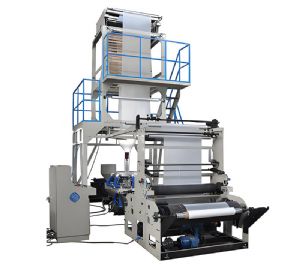
Blown Film Machine
Key technical parameters: output capacity 200-500 kg/h; thickness 100-300 µm; lay-flat width up to 4 m; BUR 2.5-3.5; melt temperature 200-230°C; frost line height 400-600 mm. The WVTR is measured per ASTM F1249. The film's tensile strength (MD) >25 MPa, elongation >300%. The puncture resistance is important to avoid tears during installation. The UV stabilizer content is 2-5% for temporary exposure. The line's energy consumption is high; using efficient blowers and motors is recommended. The quality control includes pinhole testing (using high-voltage spark testers) to ensure barrier integrity. The film is often supplied in rolls up to 1000 kg. The line can produce two smaller rolls simultaneously with a slitter. The operator must be trained to handle thick bubbles; any instability causes waste. The maintenance schedule includes regular calibration of the WVTR test equipment.
Market and application insights: construction vapor barrier films are a staple in residential and commercial building. Demand is steady and tied to construction cycles. The trend is toward higher performance films with lower WVTR and better puncture resistance, using advanced PE resins. The line's ability to produce different widths and thicknesses is important for converters serving various projects. The capital cost is moderate to high, but the margins are stable. Some lines are integrated with a lamination unit to produce reinforced vapor barriers. The film can also be printed with logos or installation guidelines. The operator must monitor the film's flatness; wrinkles cause sealing issues. The line can also produce radon barrier films, which require similar properties. Overall, the construction vapor barrier film machine is a critical asset for the building materials industry, producing films that protect structures from moisture damage and improve energy efficiency. Its operation is relatively straightforward but requires attention to quality to meet building codes and customer expectations.
