Complete multi-layer blown film line quotation
When procuring a complete multi-layer blown film line, obtaining a detailed quotation is the first step. A comprehensive quote should include not just the price, but a full technical specification, list of included components, delivery terms, payment schedule, warranty, and after-sales support. The line is typically composed of multiple extruders, a co-extrusion die, cooling system, thickness gauge, winder, and control system. Each component must be specified: extruder screw diameter, L/D ratio, motor power, gearbox type; die diameter, number of layers, die gap range; air ring blower capacity, IBC (if included); gauge type and brand; winder type and maximum roll diameter. The quotation should also list optional items: corona treater, slitter, edge trim recycling, automatic roll handling. It should state the maximum output (kg/h) for a given resin and film thickness, the line speed range, and the expected power consumption. Many suppliers provide a layout drawing showing footprint and utility requirements. Also, the quote should mention the included documentation – manuals in the local language, electrical schematics. The price can be quoted FOB (free on board) or CIF (cost, insurance, freight). FOB is typically lower but buyer arranges shipping; CIF includes shipping but may have hidden costs. Payment terms: common are 30% deposit, 50% upon shipment, 20% upon commissioning. For large orders, some suppliers offer 10% deposit, 90% on LC. The warranty is usually 12 months from commissioning or 18 months from shipment, whichever comes first. The quote should also state the lead time – from order to delivery, typically 3-6 months for Asian suppliers, 6-12 months for European custom lines.
To get the best quotation, provide the supplier with a detailed specification sheet: required film types (single-layer, 3-layer, 5-layer?), thickness range, lay-flat width, output target, resin types (PE, PP, PA, EVOH), and any special requirements (food-grade, cleanroom, high-speed). The more information you give, the more accurate the quote. Request a breakdown of costs per major component – this helps you identify where money goes and allows for cost-saving adjustments (e.g., choose a manual winder instead of automatic). Compare quotes from at least three suppliers – one high-end (European), one mid-range (Korean/Taiwanese), one budget (Chinese). Evaluate not only the price but also the technical specifications – a cheaper line may have smaller extruders, lower torque motors, or fewer heating zones. Check the included accessories – some suppliers quote a bare-bones line, while others include a full package. Ask about the availability of spare parts and the cost of consumables (screens, heater bands). Also, inquire about training: how many days, on-site or remote, and the cost. The supplier's reputation and references are crucial – ask for contacts of existing customers. If possible, visit the supplier's factory and see the line in production. For large investments, a technical negotiation meeting is recommended to clarify any ambiguities. Finally, review the contract terms carefully – ensure there are no hidden fees for installation, commissioning, or extended warranty. In summary, obtaining a complete multi-layer blown film line quotation is a structured process that requires clear communication, comparison, and due diligence. A well-prepared inquiry saves time and ensures you get the best value for your investment.
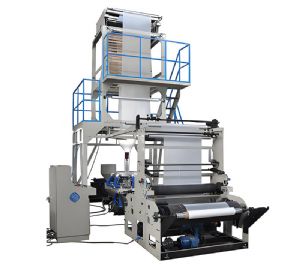
Blown Film Machine
Key elements to check in a quote: 1) Extruder details – brand of motor, gearbox, screw material (nitrided or bimetallic). 2) Die – type (spiral mandrel, stack), number of heating zones, material (tool steel or stainless). 3) Cooling – air ring type (single/dual lip), blower power, IBC brand and control. 4) Thickness gauge – brand (e.g., NDC, Zumbach), type (beta, X-ray, NIR), scan width. 5) Winder – type (surface/center), number of stations, max roll diameter, tension control. 6) Control – PLC brand (Siemens, Allen-Bradley), HMI size, software for recipe management. 7) Auxiliaries – corona treater, slitter, edge trim granulator, air compressor (if included). 8) Installation – is it included? Typically not; buyer arranges civil works and crane. 9) Training – hours, number of trainees, language. 10) Spare parts – recommended initial spare parts list with cost. 11) Compliance – CE marking, safety certifications. After receiving quotes, create a comparison matrix to evaluate each supplier's offering. Negotiate on price, payment terms, and extras – many suppliers can offer discounts or free spare parts for a larger order. Also, consider the total cost of ownership (TCO) – a higher-priced line with better energy efficiency and lower maintenance may be cheaper over 10 years. In conclusion, the quotation process is your opportunity to define exactly what you are buying. A thorough evaluation prevents surprises and ensures the line meets your production needs. Take your time, ask questions, and seek expert advice if needed. A well-negotiated contract leads to a successful equipment purchase and long-term partnership with the supplier.
