Bubble stabilization techniques
Bubble stabilization is essential for producing consistent film quality and maximizing output. An unstable bubble – oscillating, wagging, or necking – causes gauge variations, wrinkles, and even breakage. Several techniques are available, ranging from mechanical devices to process adjustments. The first line of defense is the air ring: a properly designed and maintained air ring provides symmetrical cooling. Dual-lip air rings with adjustable vanes offer better stability than single-lip. Ensure the air ring is clean and centered. The cooling air should be evenly distributed; use a smoke stick to check airflow pattern. If the bubble oscillates side-to-side, adjust vanes to balance cooling. The second mechanical aid is the bubble cage or stabilizer rings – these are guide rings placed around the bubble at intervals above the die. They physically constrain the bubble, preventing excessive movement. They are particularly useful for large bubbles or high-speed lines. The cage should be adjusted so it lightly touches the bubble without marking it. Another device is the nip roller – if the nip pressure is uneven, it can cause the film to be pulled asymmetrically, inducing oscillation. Check and adjust nip pressure uniformly. IBC (internal bubble cooling) also stabilizes the bubble because the internal air pressure provides a pneumatic support; adjusting IBC air flow can dampen oscillations. The internal pressure should be stable – use a pressure regulator and a buffer tank to smooth fluctuations.
Process adjustments for stabilization: The BUR affects stability – high BUR (≥4.0) is inherently less stable. Lowering BUR can reduce oscillation. The frost line height – if it is too high, the bubble is molten for a longer time, making it more susceptible to wind currents; lower the frost line by increasing cooling. The melt temperature – if too high, the melt strength decreases, causing neck-in; reduce melt temperature slightly (within limits). The line speed – sudden speed changes can disturb the bubble; use gradual ramps. The screw speed – if the extruder is surging, it causes pressure fluctuations that propagate to the bubble; fix surging by cleaning screens or adjusting screw speed. The air ring height above the die affects the cooling zone; lowering the air ring increases cooling intensity and can stabilize. Also, ensure the ambient air is not turbulent – close windows, turn off fans near the line. In multi-layer films, viscosity mismatches between layers can cause interfacial instability, leading to bubble oscillation. To mitigate, match the melt flow indices of adjacent layers as closely as possible, and use tie layers to smooth the interface. Some lines use a rotating die or oscillating haul-off to average out gauge variations, which indirectly improves stability because the bubble is less sensitive to localized defects. For high-speed lines, an automatic bubble control system (using ultrasonic sensors to measure bubble diameter and shape) can adjust internal pressure and cooling in real time to maintain stability. This is the most advanced technique.
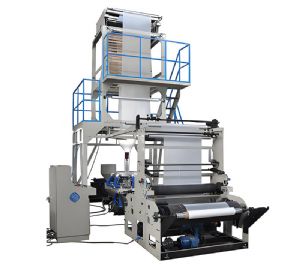
Blown Film Machine
Step-by-step stabilization procedure: 1) Clean the air ring and die lip thoroughly. 2) Check air ring alignment and vane settings – use a smoke test to ensure symmetry. 3) Adjust cooling air flow – if bubble wags, increase airflow; if it flutters, decrease. 4) Check internal pressure (for IBC) – increase slightly to stiffen the bubble. 5) Adjust BUR – if currently high, reduce by decreasing internal pressure or increasing haul-off. 6) Adjust melt temperature – lower by 5°C if melt strength is low. 7) Check nip roll pressure – ensure even, not too high. 8) Install or adjust bubble cage – set rings at 1-2 cm from bubble. 9) If still unstable, reduce line speed by 10% and re-evaluate. 10) Consider upgrading to a dual-lip air ring if using single-lip. The key is to make one change at a time to see the effect. Document successful settings. Regular monitoring of bubble shape – a stable bubble is cylindrical and symmetrical. Any tilt or wobble indicates imbalance. In conclusion, bubble stabilization is a combination of proper equipment design, regular maintenance, and skillful process adjustment. Mastery of these techniques ensures consistent film quality and high production uptime. For new lines, it is advisable to have an experienced technician during commissioning to set the initial stabilization.
