Blown film system
A blown film system refers to the complete, integrated assembly of extruder, die, cooling, haul-off, and winding with a centralized control architecture that orchestrates all process variables. Unlike a mere collection of standalone machines, a system emphasizes the interrelationship between components – for instance, the extruder speed affects melt flow, which influences bubble pressure, which then requires air ring adjustments to maintain frost line. Modern blown film systems incorporate closed-loop feedback control where thickness gauge data is automatically fed back to the die's thermal bolts or air ring segmented zones to correct gauge variations across the width. This automated gauge control (AGC) is essential for high-value films where tolerances are tight (±3%). The system also includes a recipe management database that stores optimal parameters for each film grade, enabling rapid changeovers with minimal scrap.
The core of a blown film system is its control panel – usually a PLC with a large touchscreen interface that displays real-time trends of temperatures, pressures, speeds, and thickness profiles. Advanced systems feature predictive algorithms that adjust cooling air flow or haul-off speed in anticipation of disturbances (e.g., batch changes in resin viscosity). The system integrates with upstream blending systems to ensure consistent additive levels, and with downstream winders to coordinate roll changeovers without stopping the line. For multi-layer systems, each extruder's throughput is precisely controlled to maintain layer ratios – deviations are corrected via melt pressure feedback. Additionally, the system monitors energy consumption per kg and can recommend operating points that minimize cost. Some systems incorporate machine learning to optimize parameters continuously over time, learning from operator adjustments and quality feedback.
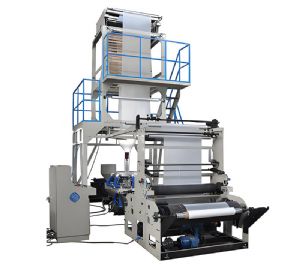
Blown Film Machine
Key subsystems in a blown film system include the extruder drive control (variable frequency drive), the die temperature control (multi-zone PID), the air ring blower speed control (to adjust cooling intensity), the internal bubble pressure control (via pressure transducer), the nip roll speed control (for thickness), and the winder tension control. All these loops are coordinated through a master controller that manages the line speed as the primary setpoint. For IBC-equipped systems, the internal cooling air flow and bubble pressure are tightly regulated to maintain bubble stability. The system also includes safety interlocks: high melt pressure shuts down the extruder, low air pressure alarms, and emergency stops at each station. Remote access capability allows off-site experts to troubleshoot and optimize processes. Data logging records all parameters for quality traceability and process improvement studies.
The benefits of an integrated blown film system are significant: reduced operator intervention, lower scrap rates, faster grade changes, and consistent film properties. For example, a system with AGC can reduce average gauge variation from ±8% to ±3%, saving material and improving roll quality. The system's self-diagnostic routines alert operators to worn heater bands, clogged screens, or misaligned nip rollers before they cause defects. Maintenance intervals can be extended through condition-based monitoring. Furthermore, the system supports Industry 4.0 communication protocols (OPC UA, MQTT) to connect with plant-wide MES and ERP systems, providing real-time production data for scheduling and inventory management. When selecting a blown film system, buyers should evaluate the controller's user-friendliness, the responsiveness of the AGC, and the availability of technical support. Retrofit kits are available to upgrade older lines with modern control systems, offering a cost-effective path to improved efficiency. Overall, the blown film system is the brain of the production line, transforming raw polymers into high-quality film with minimal waste and maximum productivity.
