Blown film line with IBC and automatic winder
A blown film line with IBC and an automatic winder represents a significant step up in productivity and automation compared to standard lines. IBC (Internal Bubble Cooling) enhances cooling efficiency by supplying chilled air inside the bubble, allowing higher line speeds (20-40% increase) and better gauge uniformity. The automatic winder (typically a turret type) enables continuous production by automatically transferring the film to a new core without stopping the line, eliminating downtime for roll changes. Together, these two features can boost overall output by 30-50% and reduce labor requirements. The IBC system includes a chiller, blower, distribution tube, and control unit that adjusts cooling air based on line speed and bubble pressure. The automatic winder has a rotating turret with two or three winding stations, servo-driven tension control, and a cut-and-transfer mechanism. The film is cut, and the tail is attached to the new core automatically. These features are standard on high-speed and high-output lines, especially for stretch film, shrink film, and multi-layer barrier films where consistent quality and high throughput are essential. The investment for IBC is typically $30,000-$80,000 (depending on capacity), and for an automatic turret winder, $50,000-$150,000. The combined cost is significant but offers a rapid payback through increased production and reduced waste.
The operational benefits are substantial: with IBC, the frost line becomes more stable, allowing higher speeds without sacrificing bubble stability. This translates to more kg/h for the same extruder size. The improved cooling also reduces haze and improves clarity for some resins. The automatic winder ensures that the line runs at full speed continuously; manual winders require deceleration and stopping for roll changes, causing thickness variations during ramp-up/down and wasting edge trim. Automatic transfer is quick (2-5 seconds) and maintains constant tension, resulting in better roll quality – no telescoping or tight cores. Labor is reduced because one operator can manage multiple lines. The line's overall efficiency (OEE) improves from 70-80% to 90-95%. Additionally, the automatic winder can handle larger roll diameters (up to 1000 mm or more), reducing downstream handling. The integration of IBC and automatic winder with the control system allows for automated recipe management: when changing products, the system adjusts cooling and winder parameters automatically. This reduces changeover time and scrap. For multi-layer lines, IBC helps maintain stable bubble shape, which is critical for layer uniformity. The energy consumption of IBC (chiller) adds about 5-10% to the line's total power, but the output increase more than compensates. The winder's motors are servo-driven, which is energy-efficient.
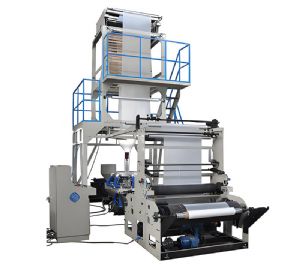
Blown Film Machine
Cost-benefit analysis: Assume a 500 kg/h line without IBC/auto-winder runs at 80% efficiency (400 kg/h effective). With IBC, speed increases 25% to 625 kg/h theoretical, and with auto-winder, efficiency improves to 95%, so effective output becomes 625*0.95 = 594 kg/h – a 48% gain. For a product margin of $500/ton, annual production (8000 hours) increases from 3200 tons to 4750 tons, adding $775,000 in revenue. The extra investment ($100k-$200k) is paid back in 3-6 months. Additionally, scrap reduction (from changeovers) saves material – typically 2-3% of output. Also, the line can run thinner films faster, further increasing yield. Therefore, for medium to large producers, IBC and automatic winder are not luxury items but essential for competitiveness. However, they require skilled maintenance – the chiller needs regular servicing, the winder's cut-and-transfer mechanism requires periodic adjustment. The control software must be correctly set for each film type to avoid mis-transfers. Operators must be trained to manage the automatic winder's jams (rare but possible). In summary, a blown film line with IBC and automatic winder is a powerful combination that delivers high productivity, consistent quality, and labor savings. The investment is quickly recovered through increased output and reduced waste, making it a top priority for any line upgrade or new purchase for high-volume production.
