Blown film extruder
A blown film extruder is the core component of any film production line, responsible for melting, homogenizing, and pressurizing the polymer resin before it exits the circular die. The extruder typically consists of a hopper, barrel, screw, heater bands, and a gearbox. The screw design, characterized by its L/D ratio (length to diameter) and compression ratio, directly influences melt quality, output rate, and energy consumption. Modern extruders incorporate barrier screws or grooved feed sections to enhance output and reduce melt temperature fluctuations. Proper temperature profiling along the barrel zones is critical to avoid degradation of heat-sensitive materials like EVOH or PA while ensuring complete melting of semi-crystalline polymers such as HDPE.
The performance of a blown film extruder is quantified by its throughput capacity (kg/h), melt pressure stability, and specific energy consumption. High-output lines often employ melt pumps (gear pumps) between the extruder and die to decouple pressure fluctuations from screw rotation, thus delivering a steady volumetric flow to the die. This ensures consistent gauge distribution across the film width. Additionally, screen changers (continuous or discontinuous) are integrated to remove contaminants and gels, protecting the die and maintaining optical clarity. Extruder wear, especially in the screw and barrel, is a common maintenance concern; hard-facing alloys and bimetallic cylinders are used for abrasive materials like LLDPE with high filler content.
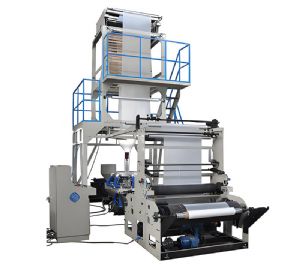
Blown Film Machine
Key technical parameters for a blown film extruder include screw speed (RPM), barrel zone temperatures, melt temperature at the adapter, and back pressure. Typical L/D ratios range from 24:1 to 30:1 for general-purpose films, up to 36:1 for high-output or high-mixing applications. The screw design can be single-stage, two-stage, or barrier-type, each suited to different polymers. For instance, a mixing section at the end of the screw improves color dispersion and melt homogeneity. Temperature control accuracy within ±1°C is essential to prevent degradation and achieve stable bubble formation. Furthermore, the extruder's motor power and gearbox torque determine the maximum output at given screw speeds; oversized motors allow processing of higher viscosity resins or running at higher fill rates.
In a complete blown film line, the extruder is often paired with a gravimetric or volumetric dosing system to feed virgin resin, masterbatch, and reclaim in precise ratios. This feeding accuracy directly impacts film color, opacity, and mechanical properties. Advanced extruders feature automatic viscosity control that adjusts screw speed based on melt pressure feedback, maintaining constant output despite changes in resin batch viscosity. The extruder also supplies the melt to a rotating or oscillating die to distribute thickness variations across the winding roll. For multi-layer film production, each layer has its own extruder, with the melt streams combined in a feed block or multi-manifold die. Proper coordination between extruder outputs is crucial for layer ratio accuracy and interlayer adhesion.
Maintenance of a blown film extruder includes daily checks of heater bands, thermocouples, and oil levels in the gearbox. Weekly inspection of the screw drive belt and alignment, monthly cleaning of the screen pack, and quarterly verification of temperature sensors. Annual overhaul involves screw pull-out to measure wear, barrel bore inspection, and replacement of bearings. Failure to maintain the extruder leads to surging, black specks, and degraded film properties. With Industry 4.0 integration, modern extruders are equipped with IoT sensors for predictive maintenance, monitoring vibration, and temperature trends. Choosing the right extruder size and configuration is the first step in designing a cost-effective blown film line for packaging, agricultural, or industrial applications.
