Blown film equipment
Blown film equipment encompasses all machinery and components required to produce blown film, from the primary extruder to the final winder. The core equipment includes the extruder (barrel, screw, motor, gearbox), the die (spiral mandrel or stack type), the air ring (single or dual lip), and the bubble stabilization cage. Auxiliary equipment includes melt pumps, screen changers (manual or hydraulic), and temperature control units (TCUs) that circulate oil or water to maintain precise die and barrel temperatures. Downstream equipment comprises the collapsing frame, nip rollers (rubber and chrome), thickness gauge (beta or infrared), corona treater (for surface treatment), edge trim slitters, and the winding station (surface or center winder, single or turret type). Each piece of equipment is selected based on the film's target specifications and production volume.
Beyond the main line, blown film equipment includes upstream material handling: vacuum loaders, gravimetric blenders, and dryers. For multi-layer films, a feed block or multi-manifold die is required to combine melt streams from multiple extruders. Additional equipment for special applications includes internal bubble cooling (IBC) systems that insert a chilled air tube inside the bubble, automatic gauge control (AGC) systems that adjust the die gap or air ring flow to correct thickness variations, and online defect detectors (optical or laser) to identify gels, holes, or contaminants. For edge trim recycling, a granulator and pneumatic conveying system are integrated. In high-end lines, an automatic roll handling system (with shaftless chucks and robot arms) reduces manual labor. Also, the control system – PLC with HMI touchscreen – is a critical piece of equipment for monitoring and logging all process parameters.
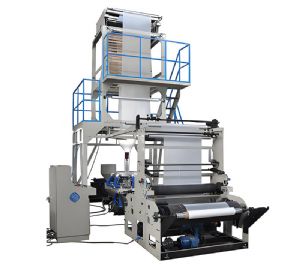
Blown Film Machine
Key selection criteria for blown film equipment include compatibility with resins (temperature, viscosity), required output range, film width and thickness tolerances, and budget. Die diameter directly affects bubble size and lay-flat width; typical sizes from 50 mm to 800 mm. Air ring design impacts cooling efficiency and film clarity – dual-lip air rings provide better cooling uniformity. Winder type influences roll hardness and ability to produce defect-free rolls; center winders allow precise tension control for thin films. Screen changers must have appropriate filtration mesh (e.g., 40-200 mesh) and heating to avoid melt freeze-off. For barrier films, equipment must be corrosion-resistant to handle PA and EVOH, which degrade and produce acidic byproducts. Additionally, the quality of mechanical components – bearings, seals, gears – determines machine lifetime and maintenance frequency. Many suppliers offer modular equipment that can be upgraded later, e.g., adding a second winder or integrating an IBC retrofit.
Maintenance of blown film equipment involves regular lubrication, cleaning of die lips and air ring, and calibration of gauges and sensors. Spare parts inventory for critical items like heater bands, thermocouples, and nip roller coverings is essential to reduce downtime. Periodic alignment checks of the extruder-to-die adapter and nip rollers prevent wear and uneven film. In modern plants, condition monitoring systems track vibration and temperature of bearings and motors, sending alerts before failure occurs. Equipment suppliers often provide training and documentation for safe operation. When purchasing used equipment, inspection should focus on screw wear, barrel scoring, and die corrosion. Overall, the right combination of blown film equipment, properly maintained and operated, ensures consistent production of high-quality film for diverse markets. The trend toward digitalization has introduced smart sensors and IIoT connectivity, enabling remote diagnostics and predictive maintenance, further enhancing equipment reliability and productivity.
