Blow-up ratio (BUR)
The blow-up ratio (BUR) is a fundamental process parameter in blown film extrusion, defined as the ratio of the final bubble diameter to the die diameter. Mathematically, BUR = Bubble Diameter / Die Diameter. Since the bubble is inflated by internal air pressure, the BUR controls the degree of transverse direction (TD) orientation imparted to the film. Typical BUR values range from 1.5:1 to 5:1, with most commercial films operating between 2.0:1 and 4.0:1. Higher BUR increases TD tear strength and impact resistance because the polymer chains are stretched more in the circumferential direction, but it reduces film thickness for a given output and increases the lay-flat width (Lay-flat ≈ π × Die Diameter × BUR / 2). BUR also influences bubble stability – too high a BUR leads to bubble oscillation and neck-in, while too low a BUR results in inadequate transverse properties and possible excessive thickness. The choice of BUR depends on the end-use requirements: packaging films often use BUR 2.5-3.5 for balanced properties, while heavy-duty sacks may use BUR 3.5-4.5 for high tear strength.
Calculating BUR is straightforward in production: measure the bubble circumference (or diameter) at the frost line using a laser or manual gauge, and divide by the die diameter. In practice, the lay-flat width is easier to measure: BUR = (2 × Lay-flat width) / (π × Die diameter). For instance, if lay-flat is 800 mm and die diameter is 200 mm, BUR = (2×800)/(π×200) = 1600/628.3 ≈ 2.55. Operators adjust BUR by changing the internal bubble pressure (via air flow) or the haul-off speed – increasing pressure inflates the bubble, raising BUR, while increasing haul-off speed reduces bubble diameter (lower BUR) because the film is pulled faster, reducing the inflation time. However, BUR must be balanced with the draw-down ratio (DDR), which is the ratio of die gap to final film thickness. High BUR combined with high DDR can lead to excessive orientation and brittle films. The frost line height also changes with BUR; higher BUR generally raises the frost line because more air volume requires more cooling. Therefore, BUR settings are optimized during line start-up and fine-tuned for each resin grade.
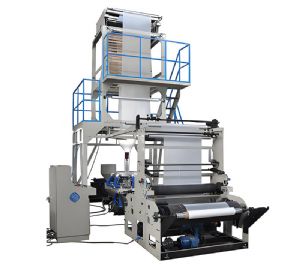
Blown Film Machine
The effects of BUR on film properties are well documented: increasing BUR (up to about 4.0) improves TD tear strength, dart drop impact, and puncture resistance, while slightly reducing optical properties (haze and gloss) due to increased surface roughness. Beyond 4.0, the bubble becomes unstable, and thickness uniformity deteriorates. For clarity films (e.g., food wraps), a lower BUR (2.0-2.5) is preferred to maintain smooth surfaces and high gloss. For shrink films, a moderate BUR (3.0-3.5) combined with balanced MD/TD orientation gives shrinkability. The relationship between BUR and MD/TD property balance is crucial: MD properties are influenced by the haul-off speed (draw ratio), while TD properties are influenced by BUR. A BUR of 2.5-3.0 often yields a balanced film suitable for general packaging. Additionally, BUR affects the film's thickness distribution – non-uniform air flow or die temperature can cause gauge bands, which become more pronounced at high BUR. Modern automatic gauge control systems can compensate by adjusting the die gap locally, but they work best within a stable BUR range. Operators must monitor bubble shape – a properly inflated bubble has a cylindrical section above the die, tapering at the frost line; any asymmetry indicates uneven cooling or pressure, which may require adjustments.
Practical tips for BUR control: always start with a conservative BUR (2.0) and gradually increase while observing bubble stability and film properties. Use a bubble cage or stabilizing ring to reduce oscillation. Ensure the air ring provides uniform cooling – uneven airflow causes localized bubble expansion. Adjust internal bubble pressure incrementally – too high pressure bursts the bubble; too low causes collapse. The BUR also interacts with output and line speed; for a given die and output, increasing BUR reduces film thickness because the same mass is spread over a larger area, so you may need to increase haul-off speed to maintain target thickness. Conversely, to increase film thickness, reduce BUR or lower speed. Many extruder controls feature a BUR setpoint that automatically adjusts internal air flow and haul-off speed to maintain constant lay-flat width. In multi-layer films, each layer's BUR is the same because they are co-extruded, but different layer materials may respond differently – for example, PA may require lower BUR due to its high melt elasticity. Overall, BUR is a powerful tool to tailor film properties, but it must be integrated with other parameters (temperature, output, cooling) to achieve consistent quality.
