Automatic thickness gauge control (AGC)
Automatic Thickness Gauge Control (AGC) is a closed-loop system that continuously measures film thickness across the width and adjusts the die gap locally to correct deviations, ensuring uniform film thickness. The system consists of a scanning thickness gauge (beta, X-ray, or NIR), a control computer with proprietary algorithms, and actuators (thermal bolts or piezoelectric devices) on the die that expand or contract the die gap at specific circumferential positions. The gauge scans the film at high speed (typically 50-200 scans per minute) and generates a thickness profile. The AGC computer compares the profile to the target and calculates corrections for each die bolt. The corrections are applied as heat or cooling to the bolts, which changes their length and thus the die gap. This feedback loop operates continuously, reducing thickness variation from ±8-10% to ±3-5% or even ±2% for high-end systems. AGC is essential for producing high-quality films, reducing material usage (since you can run closer to minimum thickness), and improving downstream converting yields. The system can also control average thickness by adjusting the haul-off speed, but the primary function is profile control. The AGC algorithm must be carefully tuned – too aggressive leads to overshoot and oscillation; too slow leaves variations uncorrected. Modern AGC uses predictive and adaptive control, learning from past corrections.
The components of an AGC system: the gauge – beta gauges are common for overall thickness, while NIR can measure individual layers in multi-layer films. The gauge scanning mechanism moves the sensor across the width on a track. The control computer is often integrated into the line's PLC or a separate industrial PC. The actuators – thermal bolts are most common; they are heated by cartridge heaters or cooled by air. Each bolt (typically 20-60 around the die) has its own temperature controller. Some advanced dies use piezoelectric actuators for faster response but at higher cost. The control algorithm can be based on the "profile" method: the computer calculates a correction factor for each bolt based on the thickness error at that angle. The correction is applied as a temperature change: a thin spot requires heating the bolt (to expand and increase gap), a thick spot requires cooling. The system also compensates for the gauge's dead time (time between scanning and bolt response) using predictive models. The AGC can be set to manual or automatic mode; in manual, the operator adjusts bolts individually. In automatic, the system runs independently. The AGC settings (gain, deadband, update frequency) are critical; they are often determined during commissioning by the supplier's engineer. Operators need to monitor the AGC performance – if the profile does not improve, there may be a problem with the gauge calibration, bolt heaters, or die contamination. Regular maintenance includes cleaning the gauge window, calibrating with standards, and checking bolt heater resistance. In summary, AGC is a powerful tool that transforms a basic line into a precision one, delivering significant material savings and consistent quality. It is a must-have for any line producing film for demanding applications.
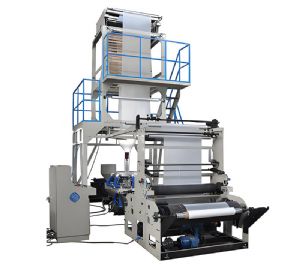
Blown Film Machine
Tuning tips for AGC: – Start with conservative gain values to avoid oscillation. – Set deadband (the error below which no correction is made) to about 0.5-1% of target thickness to avoid unnecessary adjustments. – Increase update frequency for faster response (but not too fast to cause hunting). – Use profile averaging to reduce noise. – For multi-layer films, if using NIR, tune each layer's AGC separately but coordinate them. – Regularly check the gauge's alignment – if it's off-center, the profile will be skewed. – Run a "profiling" trial to see the natural variation; then set AGC to correct. – If the AGC seems ineffective, check the die bolts for proper functioning – a stuck bolt prevents correction. – Calibrate the gauge monthly. – Document the AGC settings for each product; they may differ. In operation, the AGC display shows the current profile, target, and corrections. Operators should watch for trends – if corrections are consistently in one direction, it indicates a systematic issue (e.g., non-uniform cooling). The AGC also has alarms for excessive corrections or gauge failure. A well-tuned AGC can reduce thickness variation by 50-70%, saving 3-5% of material. This alone often pays for the investment in less than a year. In conclusion, AGC is an indispensable asset for modern blown film lines, enabling high-quality production with minimal waste.
