Air ring pressure / airflow
The air ring is the primary cooling device in a blown film line, delivering a high-velocity stream of air onto the molten bubble surface to solidify the film. Air ring pressure (measured in Pascals or inches of water) and airflow (volume per minute, e.g., m³/h) determine the cooling intensity and uniformity. The air is supplied by a blower (centrifugal or regenerative) and directed through a ring with adjustable lips, vanes, or holes. The pressure and flow must be sufficient to remove the heat from the melt to maintain a stable frost line at the desired height. Too little airflow results in a high frost line, slow cooling, and potential bubble instability; too much airflow causes a low frost line, rapid quenching that traps orientation and reduces clarity, and may even collapse the bubble if the pressure is excessive. Typically, air ring blowers are rated for flow rates from 1000 to 10,000 m³/h depending on line size, with discharge pressures of 2000-5000 Pa. The airflow is adjusted by changing the blower frequency (inverter speed) or by manual dampers. For consistent cooling, the airflow must be uniform around the entire circumference; any asymmetry causes local thickness variations and bubble wandering.
The relationship between air ring pressure/airflow and frost line height is inverse: higher airflow lowers the frost line (faster cooling), and lower airflow raises it. However, the effect is non-linear because the cooling efficiency also depends on air velocity and temperature. The air ring design plays a crucial role: single-lip air rings direct air upward to cool the bubble surface directly, while dual-lip air rings have a primary and a secondary lip that provide more uniform cooling with less turbulence. Some advanced air rings have adjustable vanes that can be angled to optimize the air flow pattern. Additionally, the air temperature affects cooling – chilled air (5-10°C) significantly increases cooling capacity, allowing higher line speeds or thicker films, but requires a chiller. In practice, operators set the blower speed to achieve the desired frost line height, and then fine-tune the air ring's lip gap or vane angle to balance cooling around the circumference. For wide bubbles, multiple fans may be used to ensure even flow. Modern lines often have an automatic air flow control that adjusts blower speed based on frost line feedback (from a camera or sensor) or based on output changes.
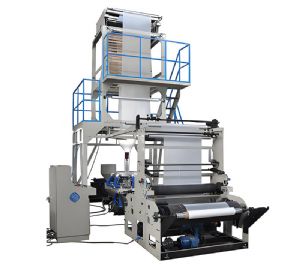
Blown Film Machine
Key parameters related to air ring pressure and airflow include the static pressure at the blower, the air velocity at the lip (typically 15-40 m/s), and the air volume per unit of film width. For a given line, operators use a manometer or pressure transducer to monitor pressure; a drop in pressure indicates a clogged filter or duct leak. The air ring should be cleaned regularly – any dirt or polymer deposits disrupt airflow, causing streaks. The blower's inlet filter must be kept clean to maintain flow. The air ring's height above the die (typically 50-150 mm) also affects cooling; lowering the air ring increases cooling intensity. The cooling efficiency is measured by the heat transfer coefficient, which increases with air velocity. However, high velocity can cause the bubble to oscillate, especially at high BUR. Therefore, a balance is needed: use the highest airflow that maintains bubble stability. For high-output lines, IBC (internal bubble cooling) is often added to supplement external air ring cooling, allowing lower external airflow to avoid bubble instability.
Practical guidelines for adjusting air ring pressure and airflow: start with the blower at 50-60% of maximum speed and observe the frost line. Increase speed gradually until the frost line is at the desired height (e.g., 400-600 mm). If the bubble oscillates, reduce speed or adjust the air ring vanes. Use a piece of string or smoke to check air flow uniformity around the bubble – if one side cools faster, the frost line will be uneven, indicating need to adjust vanes or clean that sector. For thick films, you may need maximum airflow and perhaps chilled air. For thin films, moderate airflow is sufficient; too much can cause haze. Also, consider the ambient air temperature – on hot days, you may need to increase airflow or use chilled air. The air ring should be inspected for wear; worn lips cause turbulent flow. In summary, air ring pressure and airflow are powerful tools for controlling cooling and, consequently, film clarity, strength, and gauge uniformity. Mastering these settings is essential for producing high-quality blown film efficiently.
