Agricultural mulch film machine
An agricultural mulch film machine is a blown film line specifically designed to produce films used for mulching in agriculture – covering soil to control weeds, retain moisture, moderate soil temperature, and enhance crop growth. These films are typically black (for light blocking) or translucent/silver (for insect control and temperature modification). The film thickness ranges from 15 to 50 microns, with widths up to 4 meters to cover large areas. The machine must process LDPE, LLDPE, or blends with high carbon black content (2-5%) for UV stability and opacity. The extruder screw must handle the abrasive carbon black; a bimetallic barrel and hardened screw are recommended. The die diameter is large (300-600 mm) to produce wide films. The cooling system is standard (air ring) but must be efficient to maintain bubble stability at high throughputs. The line speed is moderate (50-100 m/min) to allow uniform cooling and thickness control. The film is often wound on large rolls (up to 2 km long) to reduce field changes.
The key challenge in mulch film production is achieving uniform dispersion of carbon black and UV stabilizers to ensure long-term outdoor durability (typically 1-3 seasons). The machine includes a gravimetric feeder that accurately doses masterbatch into the virgin resin. The screw must have a strong mixing section to homogenize the additives. The film's optical properties are less critical; haze is acceptable. The mechanical strength is important – the film must withstand wind and mechanical laying equipment. Tear resistance is particularly important to prevent premature failure. The film is often embossed or perforated to allow water drainage. The machine includes a thickness gauge to maintain tolerance, but AGC is optional. The winder must handle wide, heavy rolls; a surface winder with differential tension control is common. The line often includes an edge slitter to trim the film to the exact width. The film can also be printed with branding or crop information using an in-line flexo printer. The machine's output capacity is typically 150-400 kg/h, depending on thickness and width.
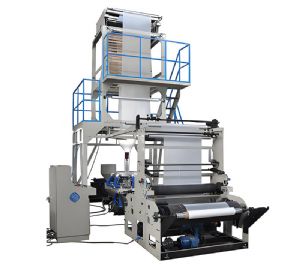
Blown Film Machine
Key parameters for the mulch film machine: melt temperature 180-210°C; BUR 2.5-3.5; frost line height 400-600 mm; die gap 1.0-1.5 mm. The carbon black content increases melt viscosity; the screw speed may need reduction. The film's thickness uniformity is critical – variations cause weak spots that tear during laying. The line should have a screen changer with a fine mesh (80-120) to remove agglomerates. The cooling air should be consistent; uneven cooling causes gauge bands. The film's properties – tensile strength, tear strength, and elongation – must meet agricultural standards. The machine can also produce biodegradable mulch films (using PLA/PBAT) with appropriate screw and temperature adjustments, though this is still niche. Maintenance: regular cleaning of the die lip to remove carbon deposits; the screw should be inspected for wear. The blower filters must be cleaned to maintain airflow. The machine's footprint is similar to a standard PE line, but the barrel may require stronger cooling because carbon black absorbs heat.
Operational and market aspects: mulch film production is seasonal, with peaks before planting seasons. Converters need to stock inventory. The cost of raw materials is a major factor; using high-quality masterbatch reduces defects. The machine can also produce silage film (for wrapping hay) with different additive packages (oxygen barrier). Many agricultural film machines are used in developing countries where labor is cheap, but automation is increasing. The trend is toward thinner films (to reduce material cost) with enhanced UV stability. The line's maintenance is straightforward, but the abrasive nature of carbon black means more frequent screw and barrel replacement. Overall, the agricultural mulch film machine is a vital tool for modern farming, enabling higher yields and reduced herbicide use. Its relatively simple technology makes it accessible to converters worldwide, and with sustainability pressures, the development of biodegradable mulch films is driving new machine designs that can process these novel materials effectively.
