Advanced Use of Active Damping and Mechanical Stabilizers for Bubble Oscillation Control 2026
Beyond passive cooling adjustments, advanced methods for controlling bubble oscillation include active damping and mechanical stabilizers. Active damping involves modulating the internal air pressure in response to the oscillation frequency. A pressure transducer measures the bubble's internal pressure, which fluctuates with oscillation. A controller applies a counteracting pressure signal (using a fast-acting valve) to dampen the oscillation. This requires a high-speed valve and a control algorithm that can detect the oscillation frequency (typically 0.5-5 Hz). The phase and amplitude of the correction signal must be tuned to cancel the oscillation. This technique is effective for high-frequency oscillations caused by air ring turbulence or vortex shedding. However, it is complex and expensive, typically used on high-speed lines. Mechanical stabilizers, such as bubble cages or guide rings, are simpler and widely used. A bubble cage is a set of ring-shaped guides (usually 2-4 rings) that are positioned around the bubble, providing physical support and preventing lateral movement. The rings have a diameter slightly larger than the bubble, and they can be adjusted vertically. The cage constrains the bubble without touching it, reducing oscillation. The rings are made of polished stainless steel or Teflon-coated to minimize friction. In summary, active damping and mechanical stabilizers are advanced options for persistent oscillation problems. The bubble cage is a cost-effective solution that can be retrofitted to most lines. Active damping requires more investment and expertise but offers dynamic control.
The bubble cage must be installed carefully; if the rings are too tight, they contact the bubble and cause defects; too loose, they provide no support. The height of the rings should be adjusted to cover the most unstable region of the bubble (typically above the frost line). The cage can be combined with air ring adjustments. For very wide bubbles, multiple cages may be used. The cage should be cleaned regularly to prevent polymer buildup. Active damping systems often use a feedforward approach, where the controller learns the oscillation pattern and applies a correction. In practice, the operator should first try conventional fixes (cooling balance, temperature), then consider mechanical stabilizers, and finally active damping for stubborn cases. In conclusion, advanced stabilization techniques are valuable tools for maintaining bubble stability in challenging conditions, enabling higher speeds and better quality. Their implementation requires careful tuning and maintenance, but the benefits in reduced scrap and improved consistency are significant.
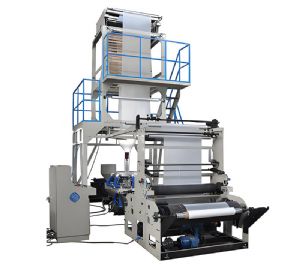
Blown Film Machine
Mechanical stabilizers: Bubble cage: 2-4 rings, adjustable diameter and height. Guide rings: similar, but may be integrated with collapsing frame. Material: polished stainless steel, Teflon-coated to reduce friction. Adjustment: rings should be 10-20 mm larger than bubble diameter. Placement: position above frost line for maximum support. Maintenance: clean rings regularly to prevent buildup. Active damping: Components: pressure transducer, fast-acting valve, controller. Principle: measure pressure oscillation, apply counter-pressure. Tuning: detect frequency, adjust phase and amplitude. Response time: <0.1 s. Integration: with IBC control system. Benefits: reduces oscillation amplitude by 50-80%. Implementation: start with passive fixes; if oscillation persists, add cage; if still unstable, consider active damping. In practice, the bubble cage is often the first advanced step; it is simple, low-cost, and effective. Active damping is reserved for high-end lines where maximum stability is required. In conclusion, combining mechanical stabilizers with active damping provides a comprehensive solution for bubble oscillation, ensuring stable production even at high speeds and challenging resin conditions.
