Advanced UV Stabilization and Anti-Block Additives in Industrial Liner Films 2026
Industrial liner films are often used outdoors and must withstand UV radiation for extended periods (up to several years). UV stabilization is achieved by adding hindered amine light stabilizers (HALS) and UV absorbers (e.g., benzophenones) to the film. These additives are typically incorporated into the outer layers (or throughout the film in single-layer). The concentration is typically 2-5% of masterbatch, providing a service life of 3-5 years. The additives must be uniformly dispersed; poor dispersion causes premature degradation spots. The extrusion line's screw must have good mixing to homogenize the additives. The melt temperature should be kept within the additive's stable range; excessive heat degrades HALS. The film's UV resistance is tested by accelerated weathering (QUV or Xenon-arc) per ASTM G154; the film must retain >80% of its tensile strength after exposure. In summary, UV stabilization is critical for outdoor liner films. The line must be capable of processing these additives without degradation, and the operator must monitor the additive feed rate and dispersion. The film's color may change; black films with carbon black (2-3%) provide excellent UV protection and are common.
Anti-block additives are used to prevent the film layers from sticking to each other during winding and use. They are typically inorganic particles (e.g., silica, talc, calcium carbonate) that create microscopic surface roughness, reducing the contact area. The particle size is typically 2-5 microns; larger particles can reduce clarity but are acceptable for liners. The anti-block additive is added to the outer layers (or the entire film) at 0.1-0.5%. The extrusion line must disperse the particles evenly; agglomerates cause gels and weak spots. The use of a masterbatch with good dispersion is recommended. Slip agents (e.g., erucamide) may also be added to reduce friction for easier handling, but they can interfere with UV stability; the selection must be balanced. In practice, the additive packages are tailored to the specific application. The operator must adjust the feeder settings accurately; even slight variations affect performance. Regular testing of UV resistance and blocking force is essential. In conclusion, the additive package (UV stabilizers, anti-block, slip) is crucial for the performance and handling of industrial liner films. The extrusion line must be capable of processing these additives with uniform dispersion, and the operator must monitor the film's properties to ensure long-term outdoor durability.
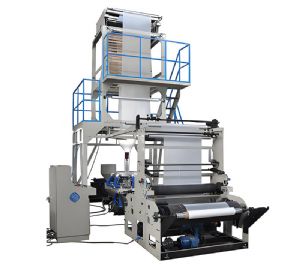
Blown Film Machine
Key additives and their functions: – UV stabilizers: HALS + UV absorbers (2-5% masterbatch). – Carbon black: provides UV protection and black color (2-3%). – Anti-block: silica, talc, CaCO3 (0.1-0.5%). – Slip agents: erucamide, oleamide (0.05-0.2%). Processing guidelines: – Melt temperature: within additive limits (typically <240°C). – Screw: barrier with mixing section for dispersion. – Feeder: gravimetric for accurate dosing. – Drying: not needed for most additives, but ensure masterbatch dry. Quality tests: – UV weathering: QUV or Xenon-arc, measure tensile retention. – Blocking force: measure force to separate film layers. – Coefficient of friction (slip). – Dispersion: visual inspection for gels. In practice, the additive masterbatches should be stored in a dry, cool place to prevent moisture pickup. The operator should regularly check the additive feed rates and adjust if the film's properties drift. In conclusion, advanced additive technology is essential for producing durable industrial liner films, and the extrusion line must be equipped to handle these functional ingredients consistently.
