Advanced Tube Forming and Lay-Flat Control in Tubular Film Lines for Bag Production 2026
A tubular film line is a specialized blown film system that produces film in a seamless tube, which is then used directly for bag making without the need for side sealing. The tube is formed by the circular die and inflated by internal air, similar to standard blown film, but the lay-flat width is precisely controlled to match the bag width. The key challenge in tubular film lines is achieving a consistent lay-flat width and uniform tube dimensions, as any variation affects bag dimensions. The lay-flat width is determined by the BUR and the die diameter, as discussed earlier. The tube is collapsed by a collapsing frame, which must be perfectly symmetrical to avoid wrinkles. The collapsing frame consists of a set of rollers or plates that gradually flatten the bubble; the angle and pressure must be adjusted for each film width and thickness. After the collapsing frame, the tube passes through the nip rollers, which seal the tube's edges? Actually, the tube is already sealed because it is a continuous tube; the nip rollers just flatten it. The tube is then wound as a flat roll. The lay-flat control is achieved by adjusting the internal air pressure (to change BUR) and by the nip speed. Automatic lay-flat control systems use a width sensor (e.g., ultrasonic) to measure the collapsed tube width and adjust the internal pressure to maintain the setpoint. For gusseted tubes, the collapsing frame includes gusset plates that create side folds, forming a gusset that allows the bag to open wider. The gusset formation requires precise control of the folding position and depth; the gusset plates are adjustable. The gusseted tube is then sealed at the bottom and cut to length in the bag-making machine. In summary, the tubular film line is designed for efficient bag production, with lay-flat and gusset control being the critical quality attributes. The machinery must be precise and stable to produce tubes that meet bag specifications.
The bag-making process on a tubular film line is often integrated in-line, with the extruder feeding the tube directly into a bag machine. This eliminates the need for an intermediate roll, reducing handling and saving labor. The bag machine includes a sealing station (heat seal or ultrasonic), a perforating/cutting unit, and a stacking or winding station. The sealing station must be synchronized with the line speed; the seal bar moves with the film to avoid stopping. The seal temperature and pressure must be optimized for the film material; for PE, typical seal temperature is 130-150°C, pressure 2-3 bar, and seal time 0.5-1 second. The seal must be strong enough to withstand the bag's contents. The bag machine can produce various bag styles: flat bags, gusseted bags, and T-shirt bags (with die-cut handles). For T-shirt bags, a die-cutting unit is added after the seal. The bag machine's speed must match the extrusion line's output; any mismatch requires a buffer (e.g., a festoon accumulator). In summary, the tubular film line's downstream integration with bag-making equipment is a key advantage, enabling "roll-to-bag" production in a single line. This reduces costs and improves efficiency. The control system must coordinate the extrusion and bag-making processes, ensuring seamless operation. The line's reliability depends on the precision of the lay-flat control and the bag machine's mechanisms. Regular maintenance of the sealing bars, knives, and gusset plates is essential to prevent defects. In conclusion, the tubular film line is a highly efficient system for producing bags, combining extrusion and converting in one continuous process. Its success hinges on precise lay-flat and gusset control, as well as robust bag-making equipment.
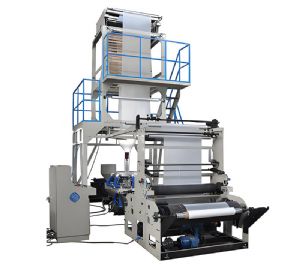
Blown Film Machine
Key parameters for lay-flat and gusset control: – Internal air pressure (controls BUR and lay-flat width). – Collapsing frame angle and pressure (affects wrinkles). – Gusset plate position and depth (for gusseted bags). – Nip roll pressure and alignment (affects flatness). – Line speed (affects tension and seal quality). – Seal temperature and pressure (affects seal strength). – Seal timing (synchronized with line speed). – Knife sharpness (affects cut quality). – Perforation depth (for easy tear-off). The control system should provide real-time feedback from sensors (width, thickness, seal quality) and adjust parameters automatically. The operator should monitor the tube for wrinkles or misalignment, and adjust the collapsing frame or gusset plates accordingly. In conclusion, the tubular film line is a specialized but essential asset for bag manufacturers. Its optimization requires attention to detail in both extrusion and bag-making. By fine-tuning these parameters, converters can produce high-quality bags with minimal waste, satisfying the demands of the retail and packaging markets. The trend toward sustainable bags (recycled or biodegradable) requires adjustments to the sealing and cutting parameters, but the basic principles remain the same.
