Advanced Troubleshooting of Bubble Instability and Oscillation in Blown Film: Root Cause Analysis and Corrective Actions 2026
Bubble instability, manifested as oscillation (side-to-side movement), wagging, or neck-in, is a common issue that leads to gauge variations, wrinkles, and even bubble breakage. The first step in troubleshooting is to observe the bubble's behavior: is the oscillation regular or erratic? Is the frost line uneven? Does the bubble tilt to one side? These observations guide root cause identification. The primary causes fall into three categories: cooling non-uniformity (air ring issues), melt flow instability (extruder surging or die temperature imbalance), and mechanical misalignment (collapsing frame, nip rolls). Cooling non-uniformity is the most frequent cause. The air ring may have dirt or polymer buildup on the lips, disrupting airflow. The air ring may be off-center relative to the die. The blower speed may be too high, causing turbulence, or too low, insufficient cooling. The solution: clean the air ring thoroughly, check centering with a dial indicator, adjust blower speed to achieve a stable frost line, and adjust vanes to balance airflow. A smoke test can visualize airflow symmetry. If the bubble tilts to one side, the airflow is uneven; adjust vanes on the corresponding side. In summary, cooling non-uniformity is the first suspect; clean and balance the air ring.
If the air ring is clean and balanced, check the die temperature uniformity. Use an infrared pyrometer to measure the die surface temperature around the circumference. Variations of more than 2°C can cause viscosity differences, leading to uneven melt flow and bubble asymmetry. Adjust individual heating zones to equalize temperature. Also, check the die lip for contamination or damage; any debris causes a localized flow disturbance. The melt temperature itself may be too high (reducing melt strength) or too low (increasing viscosity and pressure fluctuations). Adjust the barrel temperatures accordingly. Extruder surging (output fluctuations) can also cause bubble oscillation. Check the screw speed stability; if the motor RPM is steady, the surging is likely due to feed issues (hopper bridging, resin packing) or screen clogging. Clean the hopper, check the gravimetric feeder, and change the screen pack. A melt pump can stabilize pressure. In summary, if cooling is uniform, check thermal and flow stability. The melt pressure transducer readings provide clues; stable pressure indicates stable flow. In practice, the operator should systematically eliminate each potential cause, making one change at a time and observing the effect. Record the successful settings for future reference. In conclusion, fixing bubble instability requires a systematic approach, starting with the most common cause (air ring) and progressing to thermal and mechanical factors. With patience and careful observation, most instabilities can be resolved.
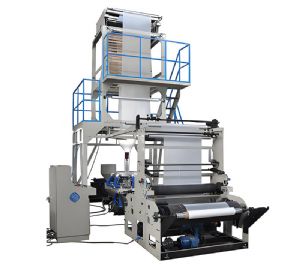
Blown Film Machine
Step-by-step diagnostic procedure: 1) Observe bubble: symmetrical? Frost line even? Oscillation frequency? 2) Clean air ring lips and vanes; check centering. 3) Adjust blower speed and vanes; use smoke test. 4) Check die temperature uniformity with pyrometer; adjust zones. 5) Clean die lip; inspect for damage. 6) Check extruder melt pressure; if fluctuating, check feed and screen. 7) If surging, reduce screw speed or adjust barrel temperatures. 8) Check collapsing frame alignment and nip roll pressure. 9) If using IBC, check internal pressure stability and flow balance. 10) Reduce line speed temporarily; if instability stops, increase cooling. Corrective actions: For cooling asymmetry: clean and balance air ring. For die temperature imbalance: adjust zone heaters. For melt surging: change screen, clean hopper. For mechanical misalignment: realign collapsing frame and nip rolls. For high BUR: reduce BUR (lower internal pressure). For low melt strength: reduce melt temperature or add LDPE to blend. Preventive measures: Regular cleaning of air ring and die lip. Daily check of die temperature zones. Monitor melt pressure trends. Use a bubble cage for large bubbles. Train operators to recognize early signs. In practice, the operator should keep a log of instability events and solutions to build a knowledge base. In conclusion, systematic troubleshooting of bubble instability is essential for maintaining consistent film quality and reducing scrap. Mastery of this skill is a hallmark of experienced blown film operators.
