Advanced Thickness Control Strategies for Ultra-Thin and Heavy-Gauge Blown Films 2026
Producing ultra-thin blown films (below 10 microns) presents significant challenges due to the need for extreme melt strength, precise cooling, and high line speeds. At such thin gauges, the film has very low mechanical resistance in the molten state, making the bubble prone to collapse or tearing. The resin must have a high melt flow index (MFI) to reduce viscosity, but high MFI often reduces melt strength. Therefore, special grades (e.g., mLLDPE with broad molecular weight distribution) are used. The die gap must be very small (0.5-0.8 mm) to achieve the required draw-down ratio (DDR) without causing melt fracture. The DDR, which is the ratio of die gap to final thickness, can be as high as 50-100 for ultra-thin films. This high DDR requires excellent melt homogeneity; any gel or contaminant will cause a hole. The cooling system must be extremely efficient to freeze the film quickly; a high frost line (low cooling) would allow the film to stretch uncontrollably. Therefore, the air ring must deliver high-velocity, chilled air, and IBC is almost mandatory. The line speed is very high (200-300 m/min) to achieve the thin thickness with reasonable output. The thickness gauge must have high resolution and fast response, and the AGC must be tuned to correct the profile without overcorrecting. The film's optical properties are often excellent due to the high cooling rate, but mechanical strength (e.g., tear) may be lower because of low orientation. In summary, ultra-thin film production is a demanding application that requires a combination of high-performance resins, precise die gap, intense cooling, and fast control systems. It is typically used for lightweight bags and liners where material savings are paramount.
Producing heavy-gauge blown films (over 200 microns, up to 300 microns) poses different challenges: the film has high thermal mass, requiring slow cooling to avoid internal stress and warpage. The line speed is low (10-20 m/min), and the output is limited by the cooling capacity. The die gap must be wide (2-3 mm) to achieve the thickness with a reasonable DDR (typically 5-15). The melt temperature must be high enough to ensure flow, but not too high to cause degradation. The cooling air must be gentle to avoid quenching the thick film, which would cause haze and brittleness. IBC is often used to provide uniform cooling from both sides, reducing the temperature gradient. The frost line height is high (500-800 mm) to allow slow solidification. The bubble stability is generally good because of the thick wall, but the heavy weight of the film can cause sagging; the collapsing frame must be carefully adjusted. The thickness gauge must be calibrated for thick films, as beta and X-ray gauges have different absorption characteristics. The AGC must be tuned to correct the profile, but the thermal bolts respond slowly; the control loop must have long integration times. The film's mechanical properties – high tensile strength, low elongation – are suitable for industrial uses. In summary, heavy-gauge film production requires a different set of process conditions, with slow speeds, moderate cooling, and careful handling. The line must be designed with sufficient cooling capacity and robust mechanical components to handle the heavy film. Both ultra-thin and heavy-gauge films are niche markets, but they offer higher margins for converters who can master the required technologies.
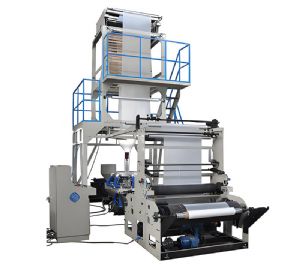
Blown Film Machine
Key parameters for ultra-thin films: – Die gap: 0.5-0.8 mm – DDR: 50-100 – Line speed: 200-300 m/min – Cooling: chilled air + IBC – Resin: high MFI with high melt strength – AGC: fast response, high resolution – Film properties: high clarity, low tear strength For heavy-gauge films: – Die gap: 2-3 mm – DDR: 5-15 – Line speed: 10-20 m/min – Cooling: moderate, with IBC – Resin: low MFI, high strength – AGC: slow response, stable control – Film properties: high tensile, low elongation In both cases, the die and air ring must be optimized for the thickness range. The resin's rheology is critical; for ultra-thin, high melt strength is needed; for heavy-gauge, low melt flow is preferred. In conclusion, the film thickness range is a key specification that drives the line design and operating conditions. Converters who can produce a wide range of thicknesses on a single line have a competitive advantage, but they must adjust their process parameters accordingly. Understanding the physics of each thickness range is essential for success.
