Advanced Tackifier Migration and Cling Control in Silage Wrap Films 2026
The cling (self-adhesion) of silage wrap film is critical for maintaining tight wrapping of bales, preventing air ingress. The cling is achieved by incorporating tackifiers, most commonly polyisobutylene (PIB), into the outer layer (or a dedicated cling layer) of the film. PIB is a low-molecular-weight, rubbery polymer that migrates to the surface over time, creating a tacky layer. The migration rate depends on the PIB molecular weight, the film's storage temperature, and the polymer matrix. Higher temperatures accelerate migration; films stored in warm conditions develop cling faster. The extrusion process must ensure uniform dispersion of the PIB in the resin; the PIB is typically fed as a masterbatch (10-20% PIB in PE) via a gravimetric feeder. The extruder screw must have good mixing (e.g., a Maddock section) to prevent agglomerates. The die temperature must be controlled to avoid degrading the PIB, which can happen above 220°C. The film's cling is tested using a peel test (e.g., ASTM D5458) after a standard storage period (e.g., 24 hours at 23°C). Typical cling values range from 2 to 5 N/15mm. Too little cling causes the wrap to loosen; too much makes unwinding difficult. In summary, controlling PIB migration is essential for consistent cling. The line's feed system, screw design, and temperature profile must be optimized to ensure uniform dispersion and controlled migration. The operator must monitor the film's cling regularly and adjust the PIB masterbatch feed rate if needed.
The migration of PIB is also influenced by the film's layer structure. In a 3-layer film with a cling layer (outer), the PIB migrates to the surface of that layer. The thickness of the cling layer affects the reservoir of PIB; a thicker layer provides more PIB for longer migration, ensuring cling over the film's shelf life. However, thicker cling layers increase cost. The migration can be accelerated by storing the film at elevated temperatures (e.g., 40°C) for a short time, but this is not common. The film's winding tension and roll hardness affect cling development; higher tension can squeeze the layers, reducing surface accessibility. The operator must ensure the winder tension is appropriate. In practice, silage wrap films are often sold with a specified cling after a given storage period. The quality control lab measures cling at regular intervals. If cling is low, the operator may increase the PIB masterbatch feed or adjust the extruder temperature. In conclusion, tackifier migration and cling control are central to silage film performance. The extrusion line must be set up to achieve consistent dispersion and migration, ensuring the film provides the necessary self-adhesion for secure bale wrapping.
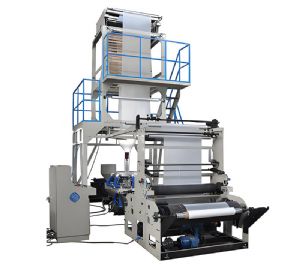
Blown Film Machine
Key factors affecting cling: – PIB concentration: typically 1-3% in the cling layer. – PIB molecular weight: higher MW gives slower migration but longer-lasting cling. – Cling layer thickness: thicker layer provides more PIB reservoir. – Storage temperature: higher temperature accelerates migration. – Storage time: cling increases with time (up to a plateau). – Film tension: high tension reduces surface contact, lowering apparent cling. – Additives: slip agents can interfere with cling; use carefully. Process control: – Feeder accuracy: ±0.5% for masterbatch. – Screw mixing: ensure uniform dispersion. – Melt temperature: avoid degradation (keep <220°C). – Die temperature: uniform to prevent localized PIB degradation. – Winder tension: moderate to allow surface migration. Quality testing: – Peel test per ASTM D5458. – Test after 24h, 48h, and 7 days to track migration. – Acceptable range: 2-5 N/15mm. – If cling too low: increase PIB feed or reduce slip agents. – If cling too high: decrease PIB feed or increase line speed (reduces residence time). In practice, the operator should establish a baseline cling profile for each product and adjust as needed. Regular calibration of the feeder and peel tester is essential. In conclusion, advanced tackifier migration and cling control are vital for producing consistent silage wrap films, requiring careful management of material feeding, extrusion conditions, and storage practices.
