Advanced Symmetry and Warpage Control in A/B/A 3-Layer Blown Films 2026
In a 3-layer A/B/A blown film, the outer layers are identical in material and thickness. This symmetry is designed to balance the internal stresses that develop during cooling and orientation, resulting in a film that lies flat and does not curl or warp. If the outer layers are not identical (e.g., different materials or thicknesses), the film will have an unbalanced stress distribution, causing it to curl towards the side with higher shrinkage or stress. This is particularly problematic for printing and lamination, where flatness is critical. Therefore, maintaining symmetry is essential for A/B/A structures. The symmetry is achieved by using the same resin in both outer layer extruders and setting their outputs to equal the same target thickness. The gravimetric feeders must be calibrated to deliver the same mass flow. The die must distribute the outer layers uniformly; any asymmetry in the flow channels will cause one outer layer to be thicker than the other. The temperature of the outer layer extruders should also be equal to ensure identical melt properties. In summary, symmetry in A/B/A films is a deliberate design choice to minimize warpage and improve handling. It simplifies production because only two different resins are needed, but it requires careful control of the outer layer extruders to maintain equal thickness. The operator must monitor the film flatness and adjust the extruder speeds if any curl is observed.
Warpage can also be caused by asymmetric cooling. If one side of the bubble is cooled faster than the other, the film on that side will shrink more, causing the film to curl. Therefore, the air ring must deliver uniform cooling around the circumference. The collapsing frame must be symmetrical to flatten the bubble evenly. The nip roll pressure must be balanced to avoid uneven stretching. In the event of warpage, the operator should first check the outer layer thicknesses using a thickness gauge; if they are unequal, adjust the respective extruder speeds. If the thicknesses are equal, check for cooling asymmetry; clean and adjust the air ring vanes. The use of an IBC can help balance cooling. In practice, warpage is a common issue in A/B/A films, especially when the core layer has a different shrinkage behavior. The use of a core layer with similar shrinkage to the outer layers can minimize warpage. In summary, warpage control in A/B/A films involves ensuring symmetry in layer thickness, temperature, and cooling. By maintaining a balanced process, converters can produce flat films that are easy to convert. In conclusion, the A/B/A 3-layer structure is a powerful concept for producing balanced films. Its success depends on the precision of the outer layer control and the uniformity of cooling. With proper process management, it yields high-quality, warp-free films for demanding applications.
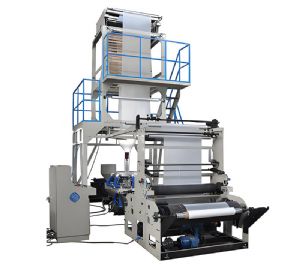
Blown Film Machine
Causes of warpage: – Unequal outer layer thicknesses (symmetry broken). – Different shrinkage of core vs. outer layers. – Asymmetric cooling from air ring. – Uneven nip roll pressure. – Uneven winding tension. – Non-uniform die temperature. Diagnosis: – Measure outer layer thicknesses (if possible, via NIR or microscopy). – Check frost line symmetry; if one side lower, adjust air ring. – Verify nip roll pressure balance. – Inspect film for curl direction; it curls towards the side with higher stress. – Run a flatness test: lay film on a flat surface; observe curl. Solutions: – Adjust outer extruder speeds to equalize thickness. – Adjust air ring vanes to balance cooling. – Use a core layer with similar shrinkage to outer layers. – Reduce cooling asymmetry by cleaning air ring. – Adjust nip roll pressure to be even. – For persistent warpage, consider using a different core resin. In practice, warpage is often corrected by adjusting the outer layer extruder speeds based on thickness profile measurements. If the curl is severe, the process may need to be re-optimized. In conclusion, symmetry and warpage control are key quality attributes for 3-layer A/B/A films. By understanding the root causes and applying systematic corrections, converters can produce flat films that meet customer specifications.
