Advanced Stretch Wrap Extruder: High-Molecular-Weight LLDPE Processing for High-Performance Film 2026
A stretch wrap extruder is a specialized blown film line for producing high-performance stretch film used to unitize pallet loads. The film is typically 15-30 µm thick, with high puncture resistance, tear strength, and elongation (>300%). The primary resin is high-molecular-weight LLDPE (HMW-LLDPE) or mLLDPE, which provides the required strength. The extruder screw must be a barrier type with a high compression ratio (3.0-3.5:1) to handle the high viscosity. The barrel must have strong cooling to manage shear heating. The die is often an oscillating type to average out gauge bands. The cooling system is high-efficiency, with a dual-lip air ring and IBC to achieve high output. The line speed is high (150-250 m/min). The key challenge is controlling the cling (self-adhesion) of the film, which is achieved by adding tackifiers (e.g., polyisobutylene) to the outer layer (or a separate cling layer in multi-layer films). The cling must be consistent; too little causes poor load retention, too much makes the film difficult to unwind. The line often includes an in-line pre-stretch unit that stretches the film before winding, reducing its thickness and increasing the yield for the end-user. In summary, the stretch wrap extruder is a high-speed, high-output line optimized for processing HMW-LLDPE and controlling cling. The operator must monitor the melt pressure and temperature; high viscosity requires careful temperature control. The cling level is tested by measuring the force required to peel the film from itself.
The pre-stretch process is a key differentiator for stretch film. The film is stretched in the machine direction (MD) before winding, typically to 100-300% of its original length. This reduces the film thickness and increases the yield per roll, but it also increases the tensile strength and reduces the tear resistance. The pre-stretch ratio is controlled by the speed difference between the nip rolls and the winder. The film's elongation and recovery after pre-stretch are critical; the film should recover partially to maintain cling. The line's control system must coordinate the pre-stretch with the extrusion speed. The winder must maintain consistent tension to avoid wrinkling. In practice, the stretch film line often produces both hand wrap (lower pre-stretch) and machine wrap (higher pre-stretch). The operator must adjust the process parameters accordingly. In conclusion, the stretch wrap extruder is a specialized line that combines high-output extrusion with in-line pre-stretch to produce high-performance pallet wrap film with controlled cling and strength.
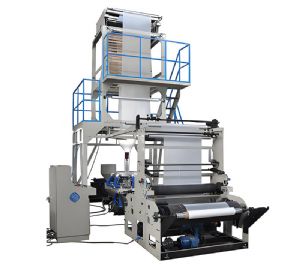
Blown Film Machine
Key resin parameters: – HMW-LLDPE: density 0.918-0.922, MFI 0.5-1.0. – mLLDPE: for enhanced strength and clarity. – Blends: with LDPE for processing ease. Additives: – Tackifier: polyisobutylene (PIB) for cling. – Slip agent: for machine wrap (reduced cling). – Processing aids: to reduce melt fracture. Process parameters: – Melt temperature: 200-220°C. – BUR: 3.0-4.0 for high TD strength. – Line speed: 150-250 m/min. – Pre-stretch ratio: up to 300%. – Film thickness: 15-30 µm. – Cling force: measured in grams. Quality tests: – Tensile and tear (MD/TD). – Puncture resistance. – Cling (self-adhesion). – Pre-stretch retention. In practice, the stretch film line is often run 24/7 to meet high demand. The operator must regularly check cling and adjust tackifier feed. In conclusion, the stretch wrap extruder is a high-performance line that produces essential packaging film for logistics, requiring careful resin selection, additive control, and pre-stretch optimization.
