Advanced Strategies for High-Line-Speed Blown Film Production: Cooling, Stability, and Winding 2026
Achieving line speeds above 200 m/min in blown film production requires a combination of enhanced cooling, precise bubble control, and high-performance winding. The primary challenge is cooling: at high speeds, the film spends less time in the cooling zone, so the heat removal rate must be extremely high. This is achieved by using a high-efficiency air ring with a dual-lip design that provides a high-velocity, uniform air flow. The air is often chilled (5-10°C) to increase the temperature difference, and IBC is used to cool the film from the inside. The combination of external and internal cooling can increase the allowable line speed by 30-50%. The bubble stability at high speeds is maintained by using a bubble cage, precise pressure control, and a robust control system that adjusts internal pressure and cooling in real-time. The frost line must be maintained at a low height (300-400 mm) to ensure the film is solid before reaching the nip. The resin must have high melt strength to withstand the high draw; mLLDPE and blends with LDPE are commonly used. The die gap must be small to achieve the desired thickness with the high speed. The line speed also affects the orientation; at high speed, the MD orientation is high, which may be beneficial for strength but detrimental to tear. Therefore, the BUR must be chosen to balance the properties. The winder must be capable of handling high-speed, with automatic roll transfer and tension control to prevent telescoping. In summary, high-line-speed production is a systems engineering challenge that requires coordinated design of the cooling system, bubble control, resin selection, and winding. The investment in these technologies is justified by the significant increase in output and reduction in cost per kg.
The control of high line speeds requires advanced automation. The line's control system must have fast response times to adjust cooling air and internal pressure to maintain the frost line and bubble diameter. The thickness gauge must have high scan speed and resolution, and the AGC must be tuned for fast response. The use of model predictive control (MPC) is beneficial because it can anticipate the effect of speed changes and adjust cooling proactively. The winder's tension control must be precise; servo-driven dancers and load cells provide feedback. The edge trim recycling system must be capable of handling the high trim volume. The operator must be trained to manage high-speed production; any disturbance can cause a catastrophic bubble collapse, so the control system must have robust safety interlocks. In practice, the maximum line speed is determined by the slowest component, often the cooling system. By upgrading the air ring and adding IBC, many lines can increase their speed by 20-30%. The use of a melt pump also helps by providing stable melt flow, reducing thickness variations that become more critical at high speed. In summary, high-line-speed production is the goal of many converters, and it is achievable with the right equipment and expertise. The benefits in productivity and cost are substantial, making it a worthwhile investment. In conclusion, high-line-speed blown film production represents the forefront of extrusion technology. It requires a holistic approach that integrates cooling, control, materials, and winding. By pushing the limits of speed, converters can achieve unmatched efficiency and competitiveness in the flexible packaging market.
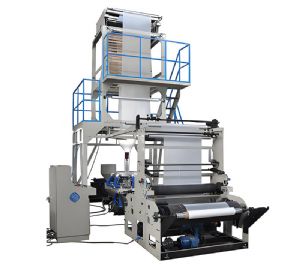
Blown Film Machine
Key technologies for high speed: – Dual-lip air ring with chilled air – Internal bubble cooling (IBC) – High-melt-strength resin (mLLDPE) – Fast-response AGC with predictive control – Advanced bubble cage – High-speed turret winder with automatic transfer – High-resolution thickness gauge – Robust safety interlocks – Operator training and support. Benefits: – Increased output (kg/h) – Lower energy per kg – Reduced labor cost – Improved delivery times – Competitive advantage. Challenges: – Higher scrap if process disturbed – More demanding maintenance – Higher capital investment. In conclusion, high-line-speed production is a strategic decision that can transform a converter's business. By investing in the necessary technologies and training, and by carefully managing the process, high speeds can be achieved reliably, delivering significant economic benefits.
