Advanced Statistical and Machine Learning Approaches for Thickness Uniformity Prediction 2026
In addition to real-time AGC, thickness uniformity can be enhanced by using statistical process control (SPC) and machine learning (ML) to predict and prevent variations. SPC involves monitoring the thickness measurement data and creating control charts (e.g., X-bar and R charts) to detect special cause variations. If a data point falls outside the control limits, an investigation is triggered. This helps identify root causes such as a change in resin, a screen clog, or a cooling disturbance. Design of Experiments (DOE) can be used to systematically study the effect of process parameters (e.g., BUR, melt temperature, cooling air) on thickness uniformity, identifying the optimal settings. Machine learning takes this further: by training a model on historical data (sensor readings and measured thickness), the model can predict the thickness profile for given process conditions. This enables proactive adjustment before a variation occurs. For example, a neural network can be trained to predict the thickness at each bolt position based on the current process parameters; if the prediction deviates from the target, the control system can adjust before the gauge even measures the error. This feedforward control can significantly reduce the response time. In summary, advanced statistical and ML methods provide a higher level of control and predictive capability. They complement AGC by addressing the root causes of variation and enabling proactive optimization. The implementation requires data collection and analysis infrastructure, but the benefits in reduced scrap and improved quality are substantial.
The integration of ML with AGC creates a hybrid control system: the ML model provides a feedforward correction based on process parameters, while the AGC provides feedback correction based on gauge measurements. This system can adapt to changing conditions (e.g., ambient temperature, resin batch) by updating the ML model online. The data required includes all relevant process parameters (temperatures, pressures, speeds, BUR) and the thickness profile. The model can be a regression model (e.g., random forest) or a deep learning model (e.g., LSTM for time-series). The model must be validated with a separate test set. The control system must have the computational capacity to run the model in real-time (typically on a industrial PC). In practice, the implementation of ML is a project that requires collaboration between data scientists and process engineers. The initial investment is significant, but the savings from reduced scrap can be substantial. In conclusion, advanced statistical and ML approaches are the next frontier in thickness uniformity control. They enable a shift from reactive to predictive quality management, reducing waste and improving consistency. As the technology matures and becomes more accessible, it will become a standard tool for high-performance blown film lines.
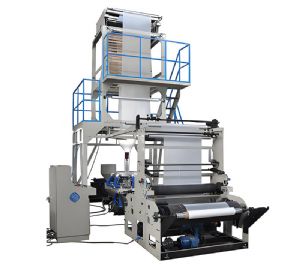
Blown Film Machine
Key SPC tools: – Control charts (X-bar, R, moving range). – Process capability indices (Cp, Cpk). – Pareto analysis of defect causes. – Root cause analysis (fishbone diagram). Key ML models: – Linear regression for simple relationships. – Random forest for non-linear and interactions. – Neural networks for complex time-series. – Support vector machines for classification of defects. Data requirements: – High-frequency data (temperature, pressure, speed). – Thickness profile from gauge. – Production recipes. – Ambient conditions. – Resin properties. Implementation steps: 1) Collect and store historical data. 2) Clean data and feature engineering. 3) Train and validate model. 4) Deploy model on edge device. 5) Integrate with control system. 6) Monitor model performance and retrain periodically. In conclusion, the combination of SPC and ML provides a powerful toolkit for achieving superior thickness uniformity. By investing in these technologies, converters can reduce waste, improve customer satisfaction, and gain a competitive edge.
