Advanced Speed Ramping and Tension Control During Haul-off Speed Changes 2026
Changing the haul-off speed during production is a common operation, either for thickness adjustment or for product changeover. However, speed changes introduce transients that can cause bubble instability, thickness spikes, or tension variations. Therefore, the speed change must be executed with a controlled ramp (acceleration or deceleration) rather than a step change. The ramp rate (m/min per second) must be set to avoid disturbing the bubble. For a typical line, a ramp rate of 1-2 m/min/s is safe; higher rates may cause the bubble to oscillate or collapse. During acceleration, the haul-off speed increases, which reduces thickness; to compensate, the extruder output must be increased simultaneously, or the cooling must be adjusted to prevent the frost line from rising too much. In practice, the control system uses a coordinated ramp that increases the haul-off speed and the extruder speed (and cooling) proportionally, maintaining the thickness and frost line. This is achieved by a master speed setpoint that scales all drives. The ramp rate can be set in the recipe. During deceleration, the opposite occurs; the extruder output is reduced to avoid a thickness increase. The tension control also needs to be adjusted; during speed change, the tension on the film changes, which can affect the winder. The winder's tension control must be able to follow the speed change; a PID controller on the winder can compensate. In summary, speed ramping is a critical aspect of haul-off speed control. Proper ramping ensures smooth transitions without quality loss. The use of coordinated ramping and tension control minimizes scrap during changeovers.
The transient stability during speed changes can be improved by using feedforward control: the control system predicts the required changes in extruder speed and cooling based on the new haul-off speed, and applies them simultaneously, rather than waiting for feedback from the thickness gauge. This reduces the magnitude of the thickness deviation. The feedforward gains must be calibrated for each product. The operator can also use a "pause" function that holds the line at the current speed while the extruder output adjusts, then resumes the ramp. In practice, the ramp rate is often set conservatively to avoid issues, but this increases changeover time. For high-speed lines, faster ramps are desirable; this requires more precise control and better cooling response. The use of model predictive control can optimize the ramp profile to minimize scrap while maintaining stability. In summary, transient control during speed changes is a complex multi-variable problem. Advanced control strategies, such as feedforward and MPC, can significantly improve performance. The operator should monitor the bubble and the thickness gauge during ramping; if instability occurs, the ramp should be aborted. In conclusion, speed ramping and tension control are essential for efficient operation. By implementing coordinated ramps and using advanced control, converters can reduce scrap during changeovers and maintain high product quality.
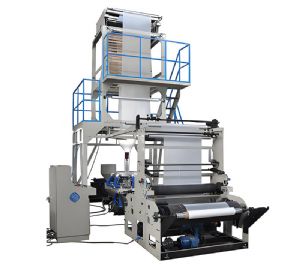
Blown Film Machine
Key parameters for ramping: – Ramp rate (m/min/s): set based on line stability. – Acceleration/deceleration time: determined by rate and speed change. – Extruder speed ramp: synchronized with haul-off speed. – Cooling adjustment: anticipatory or based on frost line feedback. – Winder tension adaptation: must follow speed. – Thickness gauge response: used for verification. Tuning: – Start with a low ramp rate (e.g., 1 m/min/s). – Increase gradually while monitoring stability. – Use feedforward gains to coordinate extruder and cooling. – For deceleration, reduce extruder speed first to avoid thickness spike. – Use a trial-and-error approach to find optimal ramp. – Document ramp settings for each product. In practice, the ramp time is often a significant part of changeover time; optimizing it can improve productivity. By using advanced control, converters can achieve ramp rates of 5 m/min/s or higher on well-designed lines. In conclusion, haul-off speed changes are a routine operation that can be optimized to minimize waste and downtime. With proper ramping and tension control, converters can achieve efficient changeovers and maintain consistent film quality.
