Advanced Single-Layer Blown Film Machine: Process Optimization for Cost-Effective Commodity Films 2026
The single-layer blown film machine is the simplest and most cost-effective configuration for producing film from a single polymer or blend. It uses one extruder, one die, and one cooling system, making it less expensive to purchase, operate, and maintain compared to multi-layer lines. However, its simplicity does not preclude the need for optimization. The key to maximizing productivity and quality on a single-layer line is to optimize the screw design for the primary resin, the cooling system for high efficiency, and the process parameters for consistent thickness and properties. The screw is typically a barrier type with a compression ratio suited to the resin (e.g., 3.0-3.5 for LLDPE). The L/D ratio is usually 28-32:1. The die is a single-manifold spiral mandrel design. The cooling system is often a dual-lip air ring with a blower; IBC may be added for increased output. The control system is simpler, with fewer zones and fewer actuators, but still requires precise temperature and speed control. In summary, the single-layer machine is the workhorse of the commodity film sector. Its optimization focuses on achieving the highest output for the lowest cost, while maintaining acceptable quality for applications like garbage bags, liners, and agricultural mulch. The key is to match the machine's capabilities to the product requirements.
Process optimization for a single-layer line involves maximizing the output (kg/h) while keeping the film properties within specification. The main limitations are the cooling capacity and the extruder's maximum torque. To increase output, one can increase the screw speed (if torque permits) and adjust the barrel temperatures to handle the higher shear. The cooling air must be increased to maintain the frost line. The use of chilled air can boost output by 10-20%. The die gap and BUR must be optimized for the target thickness and width. The gauge control, if available, can reduce thickness variation, saving material. The operator must monitor the melt temperature and pressure; if they exceed limits, the screw speed must be reduced. The line's efficiency is measured by the specific energy consumption (kWh/kg) and the scrap rate. In summary, optimization is a balance between throughput, quality, and energy. By systematically adjusting parameters and monitoring performance, converters can find the sweet spot for their single-layer line. The use of DOE and data analysis can accelerate this process. In conclusion, the single-layer blown film machine, though simple, can be highly productive when properly optimized. It remains the backbone of many film converters' operations, serving the vast market for cost-sensitive film products.
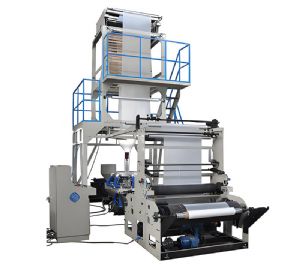
Blown Film Machine
Key optimization areas: – Screw design: barrier screw improves melting and output. – Cooling: add IBC or chilled air for higher speed. – Die gap: adjust for thickness range. – BUR: optimize for properties and stability. – Melt temperature: keep within safe range. – Line speed: set for target thickness and output. – Gauge control: manual or AGC to reduce scrap. – Resin selection: use blends to balance cost and properties. Practical steps: 1) Measure current output, thickness variation, and energy consumption. 2) Increase screw speed by 5% and adjust cooling. 3) Measure new output and quality. 4) Repeat until output limit (instability or degradation). 5) Implement AGC if not already. 6) Optimize BUR for tear/clarity balance. 7) Document final settings. In conclusion, the single-layer line is a proven, reliable workhorse. With systematic optimization, it can deliver high output with good quality, making it a profitable investment for commodity film production.
