Advanced Silage Wrap Film Machine: High-Toughness Film for Oxygen Barrier and Forage Preservation 2026
A silage wrap film machine is a specialized blown film line dedicated to producing highly stretchable, puncture-resistant, and oxygen-barrier films used to wrap cylindrical bales of hay, grass, or corn silage. The film, typically 25-50 microns thick and 500-750 mm wide, is applied in multiple layers (4-8 wraps) to create an anaerobic environment that preserves the forage's nutritional value by inhibiting aerobic spoilage. The machine must process high-molecular-weight LLDPE (HMW-LLDPE) or mLLDPE with exceptional melt strength, often blended with ethylene vinyl alcohol (EVOH) or specialized barrier resins to achieve an oxygen transmission rate (OTR) of less than 100 cc/m²/day. The extruder is equipped with a barrier screw with a high compression ratio (3.5-4.0:1) to handle the high viscosity, and a bimetallic barrel to resist abrasion from any fillers. The die is an oscillating type to average out gauge variations, and the cooling system includes a high-efficiency dual-lip air ring with IBC to ensure rapid, uniform solidification while maintaining bubble stability at line speeds of 80-120 m/min. The winder must produce rolls with consistent tension and good lay-flat, as uneven winding causes feeding problems on wrapping machines. In summary, the silage wrap line is optimized for high-toughness, barrier resins, requiring precise temperature control (melt temperature 200-230°C) and a robust extruder to deliver the high torque needed for HMW-LLDPE. The operator must monitor melt pressure and temperature closely to prevent degradation of the barrier layer. The film's cling (self-adhesion) is critical; it is achieved by adding tackifiers (e.g., polyisobutylene) to the outer layer, and the cling level must be consistent to ensure the wraps stay tight. Regular testing of OTR and puncture resistance is essential to verify film performance.
The barrier performance of silage film is achieved through a multi-layer co-extrusion structure, typically 3-layer or 5-layer. A common 5-layer structure is: sealant (cling layer) / tie / EVOH (barrier) / tie / outer (toughness layer). The EVOH layer, typically 5-10% of total thickness, provides the oxygen barrier, with an OTR that can be as low as 20 cc/m²/day for high-barrier grades. The tie layers are maleic anhydride grafted PE to bond the EVOH to the polyolefin layers. The sealant layer contains the tackifier for cling, and the outer layer provides puncture resistance and UV stability (for outdoor storage). The extrusion line must have five extruders with precise temperature control, as EVOH requires 190-220°C and tie layers require 180-200°C. The die is a multi-manifold type to allow independent temperature control for each layer. The layer ratios are critical: the barrier layer should be thin enough to minimize cost but thick enough to provide the required OTR. The line's NIR gauge measures each layer's thickness, and the AGC adjusts the extruder speeds to maintain the target ratios. In practice, the operator must ensure the EVOH is thoroughly dried (moisture <0.05%) to prevent hydrolysis, which causes gels and barrier loss. The film's cling is tested by measuring the peel force between layers; typical values are 2-5 N/15mm. In summary, the multi-layer design is the key to achieving the oxygen barrier needed for silage preservation, and the line must be capable of co-extruding EVOH with precise layer control and drying systems. The operator must be vigilant about moisture and temperature to avoid quality issues. In conclusion, the silage wrap film machine is a specialized, high-value line that produces films critical for modern agriculture, enabling high-quality forage preservation through advanced barrier and cling technologies.
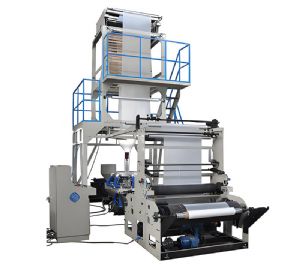
Blown Film Machine
Key silage film properties: – OTR: <100 cc/m²/day (target for 4-layer wrap). – Puncture resistance: high to withstand bale handling. – Cling force: 2-5 N/15mm for secure wrapping. – Tensile strength (MD): >35 MPa. – Elongation: >400%. – Thickness: 25-50 µm. – Width: 500-750 mm (lay-flat). Process parameters: – Melt temperature: 200-230°C (depending on layer). – BUR: 2.0-3.0 (to maintain stability). – Line speed: 80-120 m/min. – Frost line: 400-600 mm. – Cooling: dual-lip air ring + IBC. – Drying: desiccant dryer for EVOH (dew point -40°C). Quality control: – OTR testing per ASTM F1927. – Puncture testing. – Cling force measurement. – Peel strength for layer adhesion. – Visual inspection for gels and die lines. Common issues: – EVOH degradation: check moisture and melt temperature. – Poor cling: adjust tackifier feed or layer thickness. – Bubble instability: lower BUR or increase cooling. – Gauge bands: clean die and air ring; check temperature uniformity. In practice, the silage wrap line is often run seasonally with high demand in summer and autumn. The operator must maintain the drying system and monitor additive feed rates diligently. In conclusion, the silage wrap film machine is a technologically advanced line that combines high-toughness resins, barrier co-extrusion, and cling control to produce films that are essential for preserving animal feed quality, reducing waste, and improving farm efficiency.
