Advanced Sensor Technologies and Data Analytics for Blown Film Systems 2026
The performance of a blown film system is increasingly monitored by a suite of advanced sensors that go beyond traditional temperature and pressure measurements. Optical sensors, such as line scan cameras and machine vision systems, can detect surface defects (die lines, gels, pinholes) at high speed. The images are processed by AI algorithms that classify defects by type and severity, allowing immediate corrective action. Ultrasonic sensors measure film thickness and stiffness in real-time, providing data that complements the beta/NIR gauge. Infrared thermography can map the temperature profile of the bubble, identifying hot or cold spots that indicate cooling non-uniformities. Raman spectroscopy can measure the chemical composition of the film, including additive levels, which is useful for quality assurance. These sensors generate massive amounts of data, which is processed using data analytics and machine learning. For example, a neural network can be trained on historical data to predict film properties (e.g., tear strength, haze) from process parameters, enabling real-time quality prediction without destructive testing. This allows for proactive adjustments to keep the film within specification. The data can also be used for predictive maintenance, as discussed earlier. In summary, advanced sensor technologies and data analytics are transforming the blown film system into a "smart" system capable of self-diagnosis and self-optimization.
The implementation of data analytics in a blown film system involves several steps: data acquisition (sensors), data storage (historian), data preprocessing (cleaning, filtering), feature extraction (calculating statistical properties), and model building (machine learning). The models can be supervised (trained on labeled data) or unsupervised (anomaly detection). For quality prediction, a supervised model (e.g., random forest or deep learning) is trained on data sets where the film properties are measured offline. Once the model is validated, it can be deployed in real-time on the edge device (PLC or industrial PC) to predict quality continuously. If a prediction deviates from the target, the system can alert the operator or even automatically adjust the parameters. The system can also learn from new data over time, continuously improving its accuracy. The use of analytics also enables root cause analysis: when a defect occurs, the system can trace back to the contributing parameter (e.g., a temperature spike 5 minutes earlier) and help identify the cause. This reduces troubleshooting time significantly. The investment in data analytics infrastructure (sensors, software, IT) is substantial, but the return is high through reduced scrap, improved quality, and faster issue resolution. In conclusion, the modern blown film system is a data-rich environment. Harnessing that data through advanced sensors and analytics is the key to achieving world-class performance. As the cost of sensors and computing power continues to decline, these technologies will become standard in all film production, enabling a new level of process control and quality assurance.
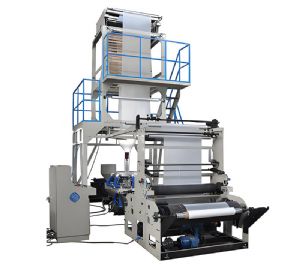
Blown Film Machine
Key sensor technologies: – Optical: line scan cameras for defect detection; hyperspectral for composition. – Ultrasonic: thickness and stiffness measurement. – Infrared: thermal imaging for bubble temperature uniformity. – Raman: chemical composition and additive quantification. – Laser: bubble diameter and shape measurement. – Acoustic emission: for detecting melt fracture or bubble oscillation. The data from these sensors is integrated into the control system via OPC UA. The analytics software can be on-premises or cloud-based. Real-time dashboards display key performance indicators (KPIs) and alerts. The system also includes a reporting module for production analysis. In conclusion, the integration of advanced sensors and analytics is a game-changer for blown film systems. It enables a shift from reactive to proactive quality management, reducing waste and increasing customer satisfaction. While the initial investment is significant, the competitive advantage gained is well worth it for converters aiming for the highest quality standards.
