Advanced Screw Wear and Its Effect on Effective L/D Ratio and Output Performance 2026
Over time, the screw flights and barrel wall wear due to abrasion from fillers, recycled material, and the friction of the polymer melt. As the clearance between the screw and barrel increases, the backflow (leakage) increases, reducing the net output for a given screw speed. This is equivalent to a reduction in the effective L/D ratio because the pressure buildup capacity is diminished. The wear is most pronounced in the metering zone, where the clearance is smallest and the pressure is highest. A worn screw can cause a 10-20% reduction in output at the same screw speed, and may also increase melt temperature due to increased shear. The effective L/D ratio can be estimated by measuring the output at a fixed screw speed and comparing it to the original output; a significant decline indicates wear. The wear can be measured directly by pulling the screw and using a micrometer to measure the flight diameter at multiple points. A clearance of more than 0.5-1.0 mm (depending on screw size) is considered excessive. The wear also affects the screw's mixing capability; worn flights cannot convey the melt effectively, leading to poor homogenization and quality issues. In summary, screw wear is inevitable but can be managed through periodic inspection and reconditioning. The wear reduces the effective L/D ratio, diminishing the extruder's performance. Monitoring output and melt temperature trends can provide early warning of wear.
The reconditioning of a worn screw involves applying a hardfacing alloy (e.g., tungsten carbide) to the flight surfaces and regrinding them to the original diameter. This restores the clearance and thus the effective L/D ratio. The process also corrects any damage to the flights. The cost of reconditioning is typically 30-50% of a new screw, and it can extend the screw's life by several years. The barrel may also require honing or sleeving if it is worn. The reconditioned screw may have a slightly different surface finish, which can affect the melt flow, but if done properly, it should perform like new. The decision to recondition or replace depends on the cost and the availability of a spare screw. Many converters keep a spare screw to minimize downtime; the worn screw is sent for reconditioning and used as a spare later. The reconditioning also allows for modification of the screw design (e.g., adding a mixing section) to improve performance. In summary, screw wear is a manageable problem. Regular measurement of output and periodic screw pull-out for inspection are recommended. By reconditioning or replacing the screw when wear is significant, converters can maintain the extruder's performance and avoid the productivity losses associated with a worn screw. In conclusion, the effective L/D ratio decreases with wear, but this can be restored through reconditioning. Proactive wear management is essential for maintaining high output and consistent film quality.
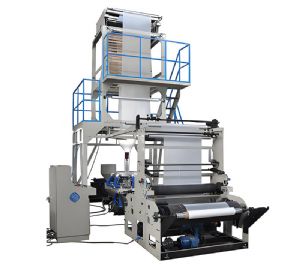
Blown Film Machine
Wear measurement methods: – Output test: compare kg/h at a fixed RPM to baseline. – Screw pull-out: measure flight diameter and barrel bore with micrometers. – Magnetic particle inspection: detect cracks. – Surface roughness measurement: assess flight surface. Indicators of wear: – Output decline >5% at same speed. – Melt temperature increase. – Increased melt pressure fluctuations. – Surging or output instability. – Film quality issues (gels, black specks). Reconditioning steps: – Clean screw thoroughly. – Build up flights with hardfacing alloy (PTA welding). – Grind to original diameter. – Polish to smooth finish. – Inspect and replace worn seals. – Check barrel and rehone if needed. – Re-install and run in. In conclusion, screw wear is a natural part of extrusion, but its effects can be mitigated through regular inspection and timely reconditioning. This ensures that the extruder continues to operate at its design capacity, maintaining the high output and quality required for competitive film production.
