Advanced Screw Diameter and L/D Ratio Selection for Optimized Melting and Output 2026
The screw diameter is the primary determinant of the extruder's output capacity; larger diameters provide higher throughput because the cross-sectional area scales with the square of the diameter. For a given screw speed, the output is proportional to D², so doubling the diameter increases output fourfold (approximately). However, larger screws also require more torque and generate more shear heating. The L/D ratio (length to diameter) influences the melting efficiency and mixing; a longer L/D provides more residence time for melting and homogenization, which is beneficial for high-melting-point or heat-sensitive resins. Typical L/D ratios for blown film extruders range from 24:1 to 36:1. A higher L/D allows better melting of LLDPE and HDPE, which have high crystallinity, but may cause degradation of heat-sensitive polymers like EVOH or PLA due to excessive residence time. Therefore, the choice of screw diameter and L/D ratio must be matched to the resin's thermal stability and viscosity. For high-output lines (500+ kg/h), a screw diameter of 120-150 mm with L/D of 30:1 is common. For barrier resins (EVOH, PA), a smaller diameter with lower L/D (24:1) and a gentle screw design is preferred. The screw's compression ratio (ratio of feed to metering channel depth) also interacts with L/D; a higher compression ratio with a longer L/D provides more intensive melting. In summary, the screw diameter and L/D ratio are foundational design parameters that determine the extruder's capability. They must be selected based on the target output, resin type, and required melt quality. The selection is typically done by the machinery supplier, based on extensive experience and simulation.
The relationship between screw diameter and output is not purely linear; the maximum screw speed decreases as diameter increases, because of shear heating and torque limitations. A 150 mm screw typically runs at 50-80 RPM, while a 75 mm screw can run at 100-150 RPM. The L/D ratio affects the pressure buildup; a longer L/D allows higher pressure, which is beneficial for high-viscosity melts but increases motor load. The screw's design also includes the flight depth and helix angle; these are optimized for the specific resin. For high-output lines, a barrier screw with a secondary flight is often used to improve melting and increase output. The L/D ratio also affects the residence time distribution; longer L/D gives a narrower distribution, which is beneficial for consistent melt quality. In practice, the screw diameter and L/D ratio are often selected based on the extruder's "output per RPM" metric. For a new line, the supplier will simulate the melting and pressure profile to ensure the screw can handle the target output. The operator should monitor the melt temperature and pressure to verify that the screw is performing as expected. If the melt temperature is too high, it may indicate that the screw is generating too much shear (perhaps too high L/D or compression ratio). In summary, the selection of screw diameter and L/D ratio is a technical decision that requires consideration of output, resin, and desired melt quality. It is best made with the help of the machinery supplier, who can provide tailored recommendations based on their expertise and simulation tools. In conclusion, the screw is the heart of the extruder; its diameter and L/D ratio set the stage for the entire process. Proper selection ensures efficient melting, high output, and consistent film quality, while poor selection leads to surging, degradation, and low productivity.
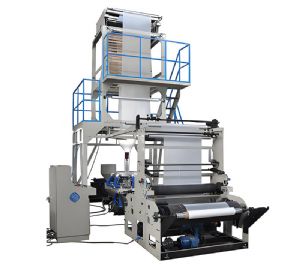
Blown Film Machine
Selection guidelines: – For PE (LDPE/LLDPE): L/D 28-32:1, diameter based on output (e.g., 90 mm for 300 kg/h). – For HDPE: L/D 30:1, barrier screw recommended. – For PP: L/D 30-32:1, high compression ratio. – For PA/EVOH: L/D 24-28:1, low shear design, corrosion-resistant material. – For high output (500+ kg/h): diameter ≥120 mm, L/D ≥30:1. – For pilot or small lines: diameter 45-75 mm, L/D 24-28:1. – For recycled materials: vented screw with longer L/D (32:1) for devolatilization. Impact of L/D: – Longer L/D → better melting, higher pressure, but more shear and residence time. – Shorter L/D → lower pressure, less shear, suitable for heat-sensitive resins. Impact of diameter: – Larger D → higher output, but lower max RPM, higher torque. – Smaller D → lower output, higher RPM, lower torque. In conclusion, the selection of screw diameter and L/D ratio is a critical design choice that must be made based on the specific application. It is advisable to consult with the screw manufacturer and use simulation to validate the design before manufacturing.
