Advanced Screw Design and Thermal Management in Blown Film Extruders: A Technical Deep Dive 2026
The blown film extruder is the primary energy conversion unit in the film production line, transforming solid polymer pellets into a homogeneous melt. Its performance is governed by the complex interplay of screw geometry, barrel temperature profile, and material rheology. The screw, typically with an L/D ratio of 28:1 to 36:1, features distinct sections: feed, compression, and metering. The feed section has deep channels to maximize solids conveying; the compression section gradually reduces channel depth to compact the polymer and melt it; the metering section maintains a constant depth to pump the melt against die resistance. Barrier screws, which include a secondary flight that separates melt from solid bed, are widely used in high-performance lines because they increase output by 20-30% while reducing melt temperature fluctuations. The compression ratio (typically 2.5:1 to 4.0:1) must be matched to the resin's thermal properties – higher for LLDPE, lower for LDPE. The screw speed, combined with the motor torque, determines the shear rate, which affects melt viscosity and temperature. High shear generates frictional heat, which can reduce the need for external heating but may also degrade heat-sensitive resins. Therefore, modern extruders use barrel cooling (air or water) in critical zones to maintain precise melt temperatures. The barrel is divided into multiple independently controlled zones (typically 4-6), each with thermocouples and PID controllers, achieving temperature uniformity within ±1°C. The melt temperature at the adapter is the most critical indicator; it should be 5-10°C below the die temperature to avoid degradation. Advanced extruders incorporate melt pressure transducers before the screen pack, providing feedback for automatic speed adjustment to maintain constant output. The gearbox, often with helical gears, must transmit high torque at low speeds (30-120 RPM) with minimal backlash. Bearing selection (angular contact for thrust, cylindrical for radial) is critical for longevity. In summary, the extruder is not a simple melter but a precision pump whose design and operation directly determine the quality and consistency of the melt fed to the die.
The thermal management of a blown film extruder extends beyond barrel heating. The screw itself acts as a heat exchanger – the flight clearance (typically 0.1-0.3 mm) creates shear that generates heat; the screw core may be cooled (especially in the feed zone) to prevent premature melting and bridging. In the compression zone, the combination of shear and conduction from the barrel melts the polymer; the melt film thickness on the barrel wall is a key variable. The specific energy consumption (SEC) in kWh/kg is a measure of thermal efficiency; modern extruders achieve 0.15-0.25 kWh/kg for PE. To reduce SEC, manufacturers use grooved feed sections that increase solids conveying, allowing lower screw speeds and less shear heating. Additionally, using a melt pump after the extruder decouples pressure generation from screw speed, enabling the screw to run at optimal RPM for melting (not pressure). The pump adds pressure (up to 400 bar) to overcome die resistance, reducing the extruder's backpressure and thus its melt temperature. This can lower SEC by 10-15%. The extruder's barrel is often made of nitrided steel for standard applications, but for abrasive resins (filled, recycled), bimetallic barrels with a tungsten carbide or chromium oxide liner are used to extend wear life. The screw itself can be hardfaced with Stellite or similar alloys. The heating system uses band heaters (ceramic or cast aluminum) with high watt density; cooling is provided by air blowers or water jackets. The control algorithm must anticipate changes: for example, when the screen pack clogs, the pressure rises, and the controller adjusts the screw speed to maintain output, but this changes the shear heating, requiring a temperature adjustment. In practice, operators monitor the melt pressure and temperature trends to predict screen changes. The extruder is also equipped with a melt filtration system (screen changer) – continuous type for high-output lines. The overall extruder performance is validated by the "output vs. screw speed" curve; a deviation indicates wear or feed issues. In summary, the blown film extruder is a sophisticated thermal-mechanical system that requires careful design, precise control, and regular maintenance to achieve high output with minimal energy and consistent melt quality. Understanding these principles enables operators to troubleshoot issues like surging, black specks, or melt fracture.
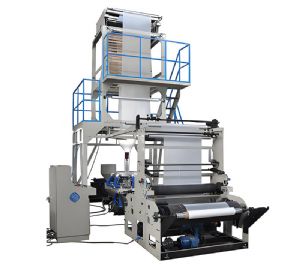
Blown Film Machine
Key technical parameters and their impact: The screw's compression ratio directly affects melting efficiency – a higher ratio increases shear but may cause overheating. The barrel temperature profile should be set such that the feed zone is 30-50°C below the melting point to prevent bridging, while the compression zone is at or above the melting point, and the metering zone is slightly lower to maintain viscosity. The melt pressure at the screen pack should be stable – fluctuations indicate surging. The motor current (amps) is a proxy for torque; a sudden increase may indicate a blockage. The residence time of the melt in the extruder should be minimized to avoid degradation; for PA and EVOH, special screws with reduced flight depth are used to minimize residence. The screw's L/D ratio influences mixing – longer screws provide better mixing but longer residence. For blends, a mixing section (e.g., Maddock or pineapple) at the end of the screw is essential to homogenize additives. The extruder's output capacity is not solely a function of screw speed; it also depends on the die pressure and the melt density. A melt pump helps maintain a linear relationship between screw speed and output, simplifying control. The wear on the screw flights increases the clearance, increasing backflow and reducing output; regular measurement of output at a fixed speed can indicate wear. For high-output lines, the extruder may have a vacuum vent to remove volatiles from recycled materials. In conclusion, the extruder is the heart of the line; its optimization requires a holistic approach considering mechanical design, thermal control, and material properties. Regular calibration of thermocouples and pressure transducers is essential for consistent performance. Operators should be trained to read trends and not just individual values. With proper care, a blown film extruder can operate reliably for decades, providing the melt foundation for high-quality film production.
