Advanced Scaling of Output Capacity in Blown Film: Extruder, Cooling, and Downstream Limits 2026
The output capacity of a blown film line, measured in kg/h, is determined by the maximum throughput of the extruder, which depends on the screw diameter, screw speed, and the resin's melt density. However, the practical output is often limited by the cooling system, which must remove the heat from the melt to solidify the film. The cooling capacity is a function of the air ring's heat transfer coefficient, the air flow rate, and the temperature difference between the melt and the cooling air. For a given film thickness and width, the cooling requirement scales with the output; higher output means more heat to remove. Therefore, the maximum output is often reached when the cooling system is at its maximum capacity, i.e., when the frost line is at its lowest stable height. If the output is increased beyond this point, the frost line rises, and the bubble becomes unstable. The downstream winder also has a maximum speed and roll weight capacity; if the line speed is too high, the winder cannot handle the rolls, causing a bottleneck. In multi-layer lines, the output is limited by the smallest extruder in the system; if one layer's extruder cannot keep up, the entire line is limited. Therefore, to increase output capacity, one must identify and upgrade the bottleneck. The extruder can be upgraded by using a larger screw, a more powerful motor, or a barrier screw design. The cooling can be improved by using a high-efficiency air ring, chilled air, or IBC. The winder can be upgraded to a faster turret type with automatic roll handling. In summary, output capacity is a system property, not just an extruder property. A systematic approach to bottleneck analysis and targeted upgrades can significantly increase the line's output, improving productivity and profitability.
The relationship between output capacity and film thickness is inverse: for a given extruder output, increasing line speed reduces thickness. Therefore, the maximum output for a thin film is higher than for a thick film because the same mass flow produces more linear meters at higher speed. However, the cooling requirement increases with speed, so the cooling system may limit the speed for thin films as well. The output capacity also depends on the resin's melt flow index; higher MFI allows higher throughput at the same screw speed, but may reduce melt strength. The use of a melt pump can increase output by reducing the extruder's backpressure, allowing it to run at a higher speed. In practice, the output capacity is often specified by the manufacturer for a given resin and film thickness. Operators can measure the current output by weighing the film produced over a known time. To increase output, they can increase the screw speed (if there is spare torque) and adjust the barrel temperatures to keep the melt temperature stable. However, they must monitor the melt pressure and temperature to avoid degradation. The cooling air flow must be increased simultaneously to maintain the frost line. The line speed must be increased proportionally to maintain the same thickness. In summary, increasing output capacity is a matter of balancing extruder throughput, cooling, and speed. It requires careful monitoring and adjustment of all parameters. By systematically testing the limits, operators can find the maximum sustainable output for each product, and by upgrading equipment, they can push those limits further. In conclusion, output capacity is a key performance indicator for blown film lines. Maximizing it while maintaining quality is a primary goal for converters. Understanding the interplay of extruder, cooling, and downstream components is essential for achieving high productivity.
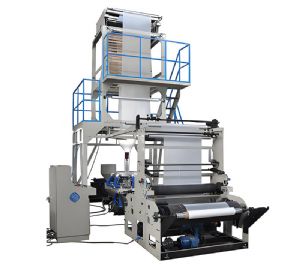
Blown Film Machine
Bottleneck identification: – Measure maximum extruder output (kg/h) at safe melt temperature. – Measure maximum line speed achievable with stable bubble (for target thickness). – Measure winder maximum speed and roll handling capacity. – The lowest of these is the practical capacity. – If extruder is the limit: upgrade screw, motor, or add melt pump. – If cooling is the limit: add IBC, chilled air, or upgrade air ring. – If winder is the limit: upgrade to turret winder with faster transfer. – If downstream is the limit: add slitter or bag machine capacity. Output increase strategies: – Increase screw speed (check torque and melt temperature). – Increase die gap (to allow higher flow, but adjust thickness with speed). – Use a melt pump to decouple pressure. – Increase cooling air flow or lower air temperature. – Increase line speed proportionally to maintain thickness. – Use a higher MFI resin (if allowed). – Reduce scrap by improving process stability. In conclusion, increasing output capacity is a systematic process of identifying and eliminating bottlenecks. It requires a combination of equipment upgrades, process optimization, and operator skill. With a focused effort, converters can achieve significant gains in output, reducing cost per kg and improving competitiveness.
