Advanced Retort and Sterilization Performance of 7-Layer High-Barrier Films 2026
Retortable pouches require films that can withstand high temperatures (121°C or higher) and high humidity during sterilization while maintaining barrier and seal integrity. The 7-layer structure is often the minimum required to achieve this, combining EVOH for oxygen barrier and PA for moisture barrier and puncture resistance. However, EVOH is sensitive to moisture; its oxygen barrier properties degrade at high humidity, which is a major challenge in retort applications. To mitigate this, the EVOH layer is often protected by PA layers or by using a high-barrier EVOH with higher ethylene content (which is less moisture-sensitive but has lower barrier). The PA layer provides moisture barrier and also helps to maintain the structure's integrity. The tie layers must be retort-resistant; MAH-grafted PP is used if the sealant and outer layers are PP-based. The film must also have good seal strength after retort. In summary, retortable films require careful selection of materials and layer structure to survive the harsh sterilization conditions. The 7-layer design allows the use of PA to protect the EVOH and provide additional functionality. The film's performance is validated by retort testing: the film is autoclaved, and then its OTR, seal strength, and adhesion are measured. The goal is to retain >80% of the initial properties. In practice, the layer thicknesses are optimized to balance cost and performance; the PA and EVOH layers are often thicker than in non-retort films.
The retort process also affects the film's dimensions; shrinkage can occur, causing wrinkles. Therefore, the film must have low shrink (<2% at retort temperature). The orientation from blown film (balanced MD/TD) helps reduce shrink, but the polymer selection is also important. PA has higher shrink than PE; its content must be controlled. The sealant layer must be retortable; PP-based sealants are common because of their high melting point. The film's moisture barrier (WVTR) is also important to prevent water loss from the package. The 7-layer structure allows the integration of a moisture barrier layer (e.g., a separate PA or HDPE layer). In summary, designing a retortable 7-layer film involves a holistic approach that considers barrier, seal, shrink, and mechanical properties. The line's process parameters must be optimized to achieve the required film properties. The operator must monitor the film's shrink and barrier properties regularly. In conclusion, the
7-layer high-barrier film line is essential for producing retortable packaging for ready-to-eat meals, pet food, and medical products. Its complexity is justified by the demanding performance requirements. With careful material selection and process control, these films provide reliable shelf life and product protection.
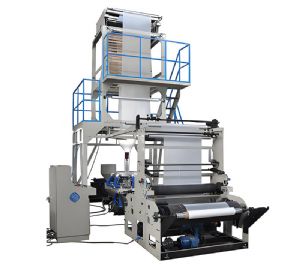
Blown Film Machine
Key retort film requirements: – OTR after retort: <5 cc/m²/day at 23°C, 50% RH. – WVTR: <1 g/m²/day. – Seal strength: >20 N/15mm after retort. – Shrinkage: <2% at 121°C. – Delamination resistance: no separation after retort. Materials: – EVOH: high ethylene (38-44%) for better moisture resistance, or standard with PA protection. – PA: provides puncture and moisture barrier; choose grades with low shrink. – Tie layers: MAH-grafted PP for PP-based systems. – Sealant: PP or high-temperature PE (e.g., mLLDPE with high melting point). – Outer: PP for heat resistance or PA for strength. Layer structure optimization: – PA layers placed on both sides of EVOH to protect from moisture. – Tie layers must be retort-resistant. – Total barrier layer thickness: typically 15-25% of total. In practice, the retort film is tested in the actual pouch form with product to ensure performance. The line must be capable of processing these materials with precision. In conclusion, retortable 7-layer films are a challenging but rewarding product, offering significant shelf-life extension for high-value food and medical products. The 7-layer line is the ideal platform for producing these films, providing the necessary layer count and process control.
