Advanced Recycled Material and Degradable Resin Processing in Shopping Bag Lines 2026
Shopping bag lines increasingly use recycled polyethylene (post-consumer) to meet sustainability goals. However, recycled resin can contain contaminants and has lower mechanical properties, affecting film strength and printability. The extrusion line must have a robust screen changer (with fine mesh) to filter contaminants. The screw and barrel should be wear-resistant. The melt temperature may need adjustment; recycled material often has a higher melt index, so the temperature can be lower. The film's tensile and tear strength are reduced; the line may need to increase thickness slightly to maintain bag strength. The printing on recycled film may have poorer adhesion; corona treatment may need higher power. In practice, the blend ratio is typically 20-50% recycled. The operator must monitor film properties and adjust process parameters. The use of processing aids can improve flow. Biodegradable resins (PLA/PBAT) are also being used, but they require different processing: lower temperatures, drying, and slower speeds. The line must be purged thoroughly when switching. In summary, processing recycled and biodegradable materials in shopping bag lines requires adjustments to filtration, temperature, and speed, and careful quality control to maintain bag performance.
The use of degradable additives (e.g., pro-oxidants) is another approach, but they can affect shelf life. The line must be able to process these additives uniformly. The film's optical properties (clarity) may be lower with recycled content. The line's AGC must maintain thickness uniformity to compensate for material variations. The bag machine's seal temperature may need adjustment for different materials. In practice, the shopping bag line is often run with a blend of virgin and recycled resin to balance cost and quality. The operator must regularly test film properties and adjust the blend ratio as needed. In conclusion, advanced recycled and biodegradable resin processing is a key trend in shopping bag lines, enabling more sustainable packaging while maintaining acceptable quality and cost.
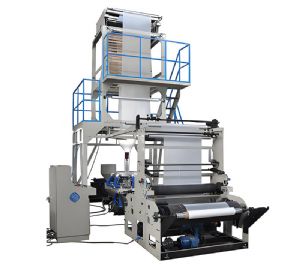
Blown Film Machine
Key considerations for recycled PE: – Filtration: screen changer with 80-120 mesh. – Wear: bimetallic barrel, hardfaced screw. – Melt temperature: lower if MFI higher. – Additives: processing aids to improve flow. – Film properties: reduced tensile and tear; may need thicker film. – Printing: higher corona power. – Blend ratio: typically 20-50%. For biodegradable resins (PLA/PBAT): – Drying: desiccant dryer, dew point -40°C. – Lower melt temperature: 160-190°C. – Slower line speed: 30-60 m/min. – Different screw: lower compression ratio. – Purging: thorough when switching from PE. – Seal temperature: adjust for PLA/PBAT. Quality tests: – Tensile, tear. – Seal strength. – Print adhesion. – Degradation rate (if applicable). In practice, the line must be flexible to handle different material types. The operator must be trained on the specific requirements of each material. In conclusion, shopping bag lines are evolving to incorporate recycled and biodegradable materials, requiring process adaptations and careful quality management to produce sustainable bags that meet performance and regulatory standards.
