Advanced Process Economics and Material Suitability: Blown Film vs Cast Film for Specific Applications 2026
When deciding between blown and cast film for a given product, converters must evaluate not only the property differences but also the economic and material handling aspects. Blown film lines have a lower capital cost for small to medium widths (up to 2 m), but the cost scales with bubble tower height and cooling system (IBC). Cast film lines have higher capital cost due to the chill roll unit, but for wide webs (over 2 m), cast lines become more cost-effective because blown film bubble stability becomes challenging at large diameters. The operating cost of blown film includes energy for air blowers (which can be significant) and higher scrap rates during start-ups and bubble breaks. Cast film lines have higher energy costs for chill roll cooling but lower scrap due to more stable operation. The material yield is also different: blown film has edge trim waste (typically 3-5%) that can be recycled in-line; cast film has similar trim but also has "neck-in" (edge narrowing) that can be up to 10% of width, requiring wider dies. In summary, the economic break-even point depends on the width and volume; for narrow widths (under 1 m) and lower volumes, blown film is often more economical; for wide webs and high volumes, cast film is preferred. Material suitability also plays a role: blown film can process higher percentages of recycled content because the bubble can tolerate some contaminants, while cast film's chill roll requires cleaner melts to avoid die buildup and roll defects. In summary, the choice is not just about film properties but about the total cost of ownership and material flexibility.
For specific applications, the process choice is often dictated by end-use requirements. For stretch wrap (pallet wrap), blown film is the dominant process because the biaxial orientation provides the needed puncture resistance and tear strength; cast stretch film exists but has lower performance. For shrink film, blown film is preferred because balanced orientation gives uniform shrink; cast shrink film would have high MD shrink and low TD shrink, causing distortion. For lamination films where high clarity and gloss are required (e.g., food overwrap), cast film is often chosen, although high-quality blown film with mLLDPE and rapid cooling can approach cast clarity. For bags and liners, blown film is the only option because of the tubular form. For industrial films (heavy gauge), blown film is more common because cast film has difficulty producing thick gauges uniformly. In practice, many converters operate both types of lines to serve different market segments. The operator training is specialized; blown film operators must be adept at bubble control, while cast film operators focus on die lip maintenance and chill roll temperature control. In conclusion, the process selection is a strategic decision based on target product properties, production volume, width, and capital availability. Understanding the strengths and limitations of each process allows converters to optimize their production portfolio and serve diverse customer needs efficiently.
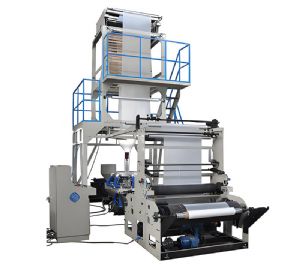
Blown Film Machine
Economic comparison: Capital cost: blown (low for <1m, high for >2m due to tower); cast (high due to chill roll, but scales linearly). Operating cost: blown (blower energy, higher scrap); cast (chiller energy, lower scrap). Material yield: blown (edge trim 3-5%, recyclable); cast (neck-in up to 10%, plus trim). Speed: cast can be faster (500 m/min vs 300 m/min). Thickness range: blown (5-300 µm); cast (10-250 µm). Width: blown up to 4m; cast up to 8m. Application suitability: Bags/liners: blown only. Shrink: blown. Stretch: blown. High-clarity overwrap: cast (or high-quality blown). Lamination film: cast (or blown with special cooling). Heavy gauge industrial: blown. Material flexibility: blown accepts more recycled content; cast requires cleaner melt. In conclusion, the process choice is a multi-factor decision; converters should evaluate their product mix, volume, and quality requirements to select the optimal process. Both technologies continue to evolve, with blown film improving clarity through better cooling and cast film improving strength through co-extrusion, narrowing the gap in some areas.
