Advanced Process Dynamics and Control in Film Blowing Machines: Bubble Formation and Stability 2026
The film blowing machine is a complex process system where the bubble's behavior is governed by the interaction of mass, momentum, and energy balances. The bubble starts at the die exit with a molten tube of radius R_die, thickness h_melt, and velocity v_melt. As the tube travels upward, it is inflated by internal air pressure, increasing its radius to R_bubble, while the haul-off speed v_haul stretches it in the machine direction. The blow-up ratio (BUR) and the draw-down ratio (DDR) determine the final film thickness and orientation. The bubble's shape is influenced by the internal pressure (P_int) and the external cooling air pressure (P_air). The stability of the bubble is described by the pressure difference across the film: ΔP = P_int - P_ext, which must balance the surface tension and the viscous stresses. A stable bubble is characterized by a cylindrical shape with a gradual taper near the frost line. The frost line height (FLH) is determined by the cooling rate; the cooling air removes heat by forced convection, with a heat transfer coefficient that depends on air velocity and nozzle geometry. The cooling rate must be sufficient to freeze the film before it reaches the nip, but not too fast to cause excessive orientation. The process is highly non-linear; small changes in cooling air or internal pressure can cause large shifts in FLH or bubble diameter. Therefore, modern film blowing machines use advanced control algorithms, including model predictive control (MPC), that anticipate the effect of changes based on a process model. The model uses inputs such as extruder output, line speed, and cooling air flow to predict FLH and bubble diameter, and adjusts the internal pressure and blower speed to maintain setpoints. In practice, operators also rely on visual observation and a bubble cage to stabilize the bubble. The cage is a set of rings that physically constrain the bubble, preventing oscillation. The internal air pressure is controlled by a valve that regulates the exhaust; a buffer tank smooths pressure fluctuations from the compressor. In summary, the film blowing machine is a dynamic system where bubble stability is achieved through a delicate balance of air pressures, cooling rates, and line speeds. Understanding these dynamics is key to producing defect-free film at high speeds.
The cooling system of a film blowing machine is not just the air ring but includes the entire cooling zone from the die to the frost line. The air ring's design (dual-lip, segmented, or with adjustable vanes) determines the air flow pattern. The primary air stream impinges on the bubble surface, creating a stagnation point; the secondary stream stabilizes the flow. The cooling efficiency is characterized by the Nusselt number, which depends on the Reynolds number of the air jet. Higher air velocity increases the Nusselt number, enhancing heat transfer, but also increases the risk of turbulence, which can cause bubble wobble. To mitigate this, some machines use a "cooling ring" with multiple small nozzles that produce laminar flow. The air temperature is another key variable; chilled air (5-15°C) can increase the heat transfer rate by 30-50% compared to ambient air, allowing a 20-30% increase in line speed. The use of chilled air requires a chiller and insulated ducts to prevent condensation. The IBC (internal bubble cooling) system adds another control variable – the internal air flow rate and temperature. The internal air cools the film from the inside, reducing the thermal gradient and allowing more uniform solidification. The combined external and internal cooling must be balanced; if one is too aggressive, the film may develop haze or brittleness. The control system for a film blowing machine often integrates a vision system that measures bubble diameter, FLH, and lay-flat width, providing real-time feedback to the controllers. The vision system uses a CCD camera and image processing algorithms to detect edges and calculate dimensions. This data is used to adjust blower speed, valve positions, and haul-off speed. Advanced systems can also detect bubble oscillation frequency and apply a counteracting pressure signal to dampen it. In summary, the film blowing machine's performance is a synergy of cooling system design, control algorithms, and operator skill. The trend is toward fully automated bubble control using AI-based models that learn from historical data and optimize settings for each resin grade. This reduces operator dependency and improves consistency. In conclusion, the film blowing machine is a testament to the integration of fluid dynamics, heat transfer, and control engineering. Mastering its dynamics enables producers to push the limits of speed and quality, meeting the ever-increasing demands of the flexible packaging market.
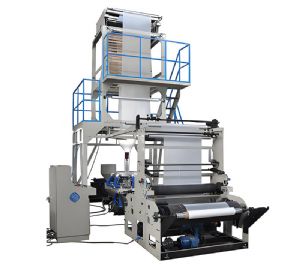
Blown Film Machine
Key control parameters and their effects: Internal air pressure – increases bubble diameter and BUR; too high causes instability. External air flow – lowers FLH; too high causes oscillation. Haul-off speed – reduces thickness; affects MD orientation. Melt temperature – affects viscosity and bubble stability; lower viscosity reduces pressure but may degrade. Line speed – directly affects output and cooling demand. The interaction between these parameters is non-linear; for example, increasing line speed requires more cooling air to maintain FLH, but too much cooling air can destabilize the bubble. Therefore, a common strategy is to use a master speed setpoint that scales all extruders, pumps, and haul-off speed, while the cooling system adjusts automatically based on a FLH setpoint. This simplifies operation and ensures consistent quality during speed changes. The film blowing machine's control system also monitors the nip roll pressure and the winder tension; any deviation can cause wrinkles. In conclusion, the film blowing machine is a sophisticated process that requires a holistic approach to control, combining mechanical design, thermal management, and automation. Advanced sensors and algorithms are transforming it from an art to a science, enabling higher productivity and quality.
