Advanced Process Control and Automation Strategies for Modern Blown Film Manufacturing Lines 2026
Modern blown film manufacturing lines are increasingly equipped with advanced process control (APC) and automation systems that go beyond traditional PID loops. APC uses models of the process to predict future behavior and optimize control actions. For example, a model predictive controller (MPC) can anticipate the effect of a change in line speed on the frost line and adjust cooling air and internal pressure proactively, rather than reactively. This results in tighter thickness control and faster recovery from disturbances. The APC system is built on a dynamic process model that is identified from step-test data and updated online. It can handle multiple inputs (e.g., screw speed, blower speed, haul-off speed) and multiple outputs (e.g., thickness, lay-flat width, frost line height) simultaneously, optimizing for quality and output. The implementation of APC requires a powerful industrial PC and significant engineering effort, but the benefits are substantial: improved uniformity (up to 50% reduction in thickness variation), increased throughput (5-10%), and reduced operator intervention. The system also includes auto-tuning for PID controllers, ensuring optimal performance of individual loops. In addition, APC can be integrated with a recipe management system that stores optimal parameters for each product, enabling rapid changeovers. The operator's role shifts from manual control to monitoring and exception handling. In summary, APC is a key technology for achieving consistent, high-quality film production with minimal scrap. It transforms the line from a manually operated machine to a self-optimizing system.
Automation in blown film manufacturing extends to the entire production environment, including material handling, quality control, and logistics. Automated guided vehicles (AGVs) transport raw materials and finished rolls, reducing labor and improving safety. Robotic arms handle core loading and roll packing. In-line quality control systems, such as vision inspection and thickness gauging, provide real-time feedback to the APC, creating a closed-loop quality system. The line's control system is integrated with the plant's Manufacturing Execution System (MES) and Enterprise Resource Planning (ERP), enabling paperless production and real-time tracking of orders, inventory, and costs. This integration also allows remote monitoring and diagnostics by the equipment supplier, reducing downtime. The concept of Industry 4.0 is realized through the use of Industrial Internet of Things (IIoT) sensors that collect data on temperature, vibration, pressure, and energy consumption. This data is analyzed by cloud-based AI algorithms that predict equipment failures and optimize production schedules. For example, AI can recommend the optimal line speed for a given resin batch based on its melt flow index, adjusting parameters automatically. The level of automation can be tailored to the plant's needs; for high-volume commodity films, a high level of automation is justified; for niche products, a moderate level may suffice. In summary, automation and APC are transforming blown film manufacturing into a smart, efficient, and data-driven operation. The investment in these technologies is significant but pays off through reduced labor, improved quality, and higher throughput. In conclusion, the future of blown film manufacturing lies in fully automated, self-optimizing lines that operate with minimal human intervention. By embracing these technologies, converters can achieve unprecedented levels of efficiency and quality, staying ahead of the competition in a demanding market.
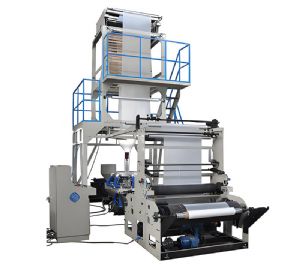
Blown Film Machine
Key automation and APC components: – Model Predictive Control (MPC) for multi-variable optimization. – Recipe management with automatic loading. – In-line quality sensors (thickness, vision, spectrometry). – Robotic roll handling and packing. – AGVs for material transport. – Integration with MES/ERP. – IIoT sensors for predictive maintenance. – AI-based process optimization. – Remote monitoring and diagnostics. – Operator dashboards with real-time KPI. Implementation steps: 1) Assess current automation level and define goals. 2) Select APC software and sensors. 3) Develop process models and tune controllers. 4) Integrate with existing MES/ERP. 5) Train operators on new systems. 6) Gradually increase automation level, monitoring performance. In conclusion, the advanced process control and automation are not just about reducing labor; they are about achieving a level of consistency and quality that is impossible with manual operation. They enable converters to produce high-quality film with minimal waste, meeting the stringent demands of modern packaging applications. As technology continues to evolve, the blown film manufacturing line will become even more intelligent and autonomous, further enhancing productivity and sustainability.
