Advanced Process Comparison: Blown Film vs Cast Film – Orientation, Cooling, and Property Trade-offs 2026
The distinction between blown film and cast film begins at the die exit. In blown film, the molten polymer emerges from a circular die as a tube, which is inflated by internal air into a bubble, cooled by external air (and optionally internal cooling), collapsed, and wound flat. This process imparts biaxial orientation: machine direction (MD) orientation from haul-off stretch, and transverse direction (TD) orientation from bubble inflation (blow-up ratio). In cast film, the melt exits a flat die (slot die) and is quenched on a highly polished, temperature-controlled chill roll, with air knives or vacuum boxes aiding contact. There is no bubble; orientation is primarily MD due to the draw ratio between die exit and chill roll, with negligible TD orientation because the film is not stretched in the width direction. The cooling rate is drastically different: blown film relies on forced convection from air (heat transfer coefficient ~50-100 W/m²K), while cast film uses conductive heat transfer to the chill roll (coefficient ~1000-2000 W/m²K), resulting in much faster quenching. This rapid quenching in cast film suppresses crystallization, yielding films with exceptional clarity and gloss, while blown film's slower cooling allows more crystallinity and orientation development. The MD orientation in cast film is typically higher, giving higher tensile stiffness, but tear strength is lower due to lack of TD orientation. Blown film, with balanced orientation, exhibits superior tear and impact resistance. The process also affects gauge control: cast film can achieve thickness tolerances of ±2-3% easily, while blown film with AGC can achieve ±3-5%, but the bubble adds complexity. In summary, the fundamental difference is the shaping and cooling method: blown uses a tube with biaxial stretching and air cooling; cast uses a flat die with chill roll quenching and uniaxial orientation. This drives all subsequent property differences.
The equipment layout reflects these differences. A blown film line includes an extruder, circular die, air ring, bubble tower (often 6-10 m high), collapsing frame, nip rolls, and winder. The tower height is necessary for cooling and orientation relaxation. A cast film line consists of an extruder, flat die, chill roll unit (with primary, secondary, and sometimes tertiary rolls), edge trim system, thickness gauge, and winder. The chill roll unit requires precise temperature control (typically 20-60°C) and a water chiller. Cast film lines are more compact horizontally but require very accurate die lip adjustment (typically via thermal bolts) and roll alignment. Blown film lines are simpler mechanically but more complex in process control (bubble stability). The line speed for cast film is generally higher (up to 500 m/min for thin films) due to efficient cooling, while blown film speeds top out around 300 m/min. However, blown film can produce thicker gauges (up to 300 µm) more easily, while cast film is typically 10-250 µm. The choice of process also affects material options: blown film can handle higher-viscosity resins (e.g., HMW-LLDPE) and is the only way to produce tubular film (bags without side seams). Cast film is preferred for high-clarity overwrap, lamination films, and applications requiring very uniform thickness. In summary, the process difference is not just equipment but a fundamental difference in how the film is formed, cooled, and oriented, leading to distinct property profiles and application niches. Understanding these differences is essential for converters to select the right process for their target product.
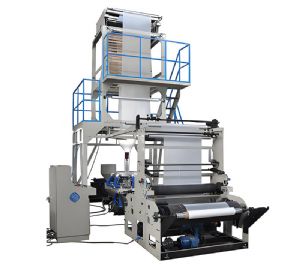
Blown Film Machine
Key property differences: Blown film: balanced MD/TD properties, higher tear and impact, moderate clarity (haze 5-15%), good puncture resistance, can produce tube film. Cast film: higher MD tensile, excellent clarity (haze <2%), high gloss, very uniform thickness, limited TD strength, cannot produce tubes. Process economics: Blown film has lower capital cost for narrow widths, simpler die, but higher operating costs due to bubble instability and scrap. Cast film has higher capital cost (chill roll, precise die), but higher speeds and lower scrap for high-volume, wide-web applications. Material selection: Blown film is compatible with a wide range of polyolefins and co-extrusions; cast film is limited to polymers with good melt strength for chill roll adhesion. Energy consumption: Blown film uses air cooling (low energy), cast film uses chill roll (requires chiller energy). Applications: Blown film dominates bags, liners, agricultural films, shrink films; cast film dominates high-clarity packaging, lamination, labels, and stretch film (where clarity is key). Troubleshooting: Blown film issues are bubble-related (instability, gauge bands); cast film issues are die-related (lip buildup, chill roll marks). The operator's skill set differs: blown film operators need bubble management skills; cast film operators need die and roll alignment skills. In conclusion, the choice between blown and cast is driven by the required film properties and application needs; both processes are essential in the flexible packaging industry.
