Advanced Plant Layout and Material Flow Optimization for High-Efficiency Blown Film Plants 2026
Designing a blown film plant requires a strategic approach to layout and material flow to minimize handling, reduce cycle times, and optimize labor utilization. The plant typically includes raw material storage (silos, gaylords), blending and drying area, extrusion lines, winding and slitting, quality control lab, and finished goods warehouse. The layout should follow a "flow" principle where material moves in a linear direction from storage to extrusion, then to converting, and finally to shipping, with minimal backtracking. The extruders are arranged in parallel, with sufficient spacing for maintenance access and roll handling. The bubble towers require high ceilings (6-10 meters), so the building must be designed accordingly. Overhead cranes or monorails are essential for moving heavy dies and rolls. The material handling system – pneumatic conveying for pellets, vacuum loaders for hoppers – should be designed with redundancy to avoid downtime. The blending area should be centralized to serve multiple lines, with gravimetric feeders that can be quickly switched between products. The edge trim reclaim system should be located near the extrusion lines to minimize transport distance. The winding area must have space for roll storage and automatic handling equipment. The layout should also consider the flow of personnel: control rooms should have a clear view of the lines; maintenance workshops should be close to the extrusion area. Safety is paramount: emergency exits, fire suppression, and ventilation must be integrated. In summary, a well-designed blown film plant layout reduces material handling costs, improves safety, and increases overall productivity by up to 20% compared to a poorly designed facility.
Material flow optimization in a blown film plant extends to the movement of finished rolls and the management of work-in-process. The use of automated guided vehicles (AGVs) or conveyor systems to transport rolls from the winder to the slitter and then to the warehouse can significantly reduce manual labor. The plant should be designed with a "pull" system where production is driven by customer orders (just-in-time) rather than forecasting. This requires flexible lines that can change products quickly. The quality control lab should be located near the extrusion lines for immediate testing; a sample should be taken every shift and tested for thickness, tensile, tear, and optical properties. The data is fed back to the production system for continuous improvement. The plant's utility infrastructure – cooling water, compressed air, power – must be sized for peak demand and have backup systems to prevent downtime. The use of energy recovery systems (e.g., heat from barrel cooling to preheat air for drying) can reduce operating costs. The plant layout should also accommodate future expansion: leaving space for additional lines or new equipment. In summary, material flow optimization is about eliminating waste (muda) in all forms – overproduction, waiting, transport, over-processing, inventory, motion, and defects. Applying lean manufacturing principles to a blown film plant can lead to significant cost savings and improved delivery performance. The plant's success depends on the synergy between layout, material handling, and operational practices. In conclusion, a blown film plant is a complex system where every square meter counts. A well-thought-out layout and optimized material flow are prerequisites for competitive production. By investing in design and continuous improvement, operators can achieve world-class efficiency and responsiveness.
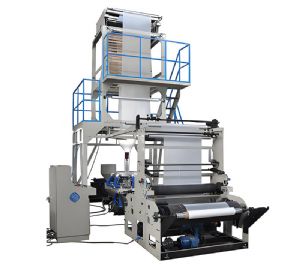
Blown Film Machine
Key design considerations: Extruder spacing – allow at least 2 meters between lines for maintenance. Tower height – determined by maximum bubble height plus crane clearance. Raw material silo placement – outdoor, with pneumatic conveying to indoor blending. Blending area – should have easy access for bagged additives. Reclaim system – should be integrated with the extruder feed to minimize manual handling. Winding area – needs space for roll transfer and palletizing. Warehouse – should have high-bay storage to maximize volume. Office and control rooms – should be enclosed and climate-controlled for operator comfort. The plant should also have a well-defined maintenance area with a workshop and spare parts storage. The electrical substation should be located near the high-power loads (extruders) to minimize voltage drop. In conclusion, the plant layout is a strategic decision that affects the plant's efficiency for its entire life. It is advisable to work with an experienced plant engineering firm to design the facility, considering both current needs and future growth. A 3D simulation of the material flow can help identify bottlenecks before construction. By optimizing the layout, converters can reduce operating costs, improve safety, and enhance their competitive position.
