Advanced Pinhole Detection and Edge Trim Recycling in Vapor Barrier Film Lines 2026
Pinholes in vapor barrier films are critical defects that compromise the moisture barrier. To detect them, the line includes an in-line spark tester (or high-voltage pin detector) located after the nip rolls. The spark tester applies a high-voltage (e.g., 10-50 kV) across the film; any pinhole or thin spot causes a spark, which is detected and the defect is marked or the film is diverted. The pinhole detection system must be calibrated for the film thickness and material; the voltage is set to detect defects without damaging the film. The operator must monitor the spark tester's sensitivity and ensure the film surface is clean and free of conductive dust. The line's AGC helps minimize gauge variations, reducing the risk of pinholes. In summary, pinhole detection is essential for vapor barrier films. The spark tester must be maintained and calibrated regularly. The operator must respond to any alarms, adjusting process parameters if pinholes increase.
Edge trim recycling is common in vapor barrier lines; the trimmed edges (typically 50-100 mm per side) are granulated and fed back to the extruder, usually to the core layer. The reclaim must be filtered to remove any metal or contaminants that could create pinholes. The granulator must produce uniform flake to ensure consistent feed. The reclaim ratio is typically 20-30%. The operator must monitor the reclaim quality and adjust the feed rate. The use of a metal detector in the reclaim feed is recommended. In practice, the reclaim system must be kept clean to avoid contamination. The film's barrier performance should be checked periodically to ensure reclaim does not affect WVTR. In conclusion, pinhole detection and edge trim recycling are key ancillary systems in vapor barrier film lines, ensuring product integrity and material efficiency. Proper maintenance and calibration are essential for reliable operation.
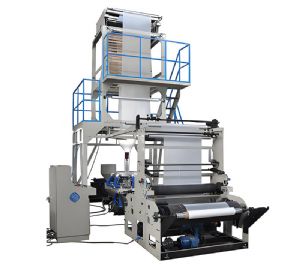
Blown Film Machine
Key components: – Spark tester: high-voltage (10-50 kV), adjustable sensitivity. – Granulator: for edge trim, producing uniform flake. – Conveying system: pneumatic or mechanical. – Metal detector: in reclaim feed. – Filtration: screen changer with fine mesh. Process integration: – Spark tester positioned after nip, before winder. – Reclaim fed to core layer extruder. – Reclaim ratio: 20-30% of total output. – Reclaim must be dried (if hygroscopic). Quality checks: – Calibrate spark tester with standard defects. – Monitor reject rate due to pinholes. – Test WVTR with and without reclaim to ensure no change. Maintenance: – Clean spark tester electrodes. – Sharpen granulator blades. – Check conveying system for blockages. In practice, the operator should log pinhole detections to track trends. If pinholes increase, check for die lip damage, screen clogging, or cooling non-uniformity. In conclusion, pinhole detection and reclaim systems are vital for producing reliable vapor barrier films, ensuring both barrier integrity and cost-effective material utilization.
