Advanced Packaging Film Extrusion Line: Multi-Layer Structures for Food and Industrial Packaging 2026
A packaging film extrusion line is designed to produce films for flexible packaging applications, ranging from food wraps and pouches to industrial bags and shrink sleeves. These lines are typically multi-layer (3, 5, or 7 layers) to provide the required combination of sealability, barrier, strength, and optical properties. The layer structure is engineered to meet specific functional requirements: a sealant layer (inner) for heat sealing; a barrier layer (EVOH or PA) for oxygen, moisture, or aroma protection; and an outer layer for printability and toughness. The materials used are often food-grade certified (FDA, EU) and may include mLLDPE, LDPE, PP, PA, and EVOH. The extruders are sized according to the layer ratios, with the core layer often being the largest. The die is a multi-manifold or feed block type, with precise temperature control for each layer. The cooling system is optimized for the film's thickness and speed, with IBC often used for high-output lines. The thickness gauge is typically an NIR type for layer-specific measurement, and AGC adjusts the die bolts and extruder speeds to maintain thickness and layer ratios. In summary, the packaging film extrusion line is a sophisticated system that combines multiple extruders, a complex die, and advanced control to produce films with tailored properties. The line must meet strict hygiene and safety standards for food contact. The operator must be trained in material handling and process optimization to achieve consistent quality.
The selection of materials for each layer is a critical design decision. The sealant layer must have good hot tack and seal strength over a wide temperature range; mLLDPE is often used. The barrier layer is chosen based on the required OTR and WVTR; EVOH provides excellent oxygen barrier, PA provides good oxygen and puncture resistance. The tie layers (if needed) are maleic anhydride grafted polyolefins. The outer layer should be compatible with printing and lamination; it may be treated with corona to increase surface energy. The layer ratios are optimized to meet performance requirements at minimum cost. The line's process parameters – melt temperature, BUR, line speed, cooling – must be tuned for the specific material combination. The die temperature is particularly critical for multi-layer lines, as different resins have different processing windows. In practice, the packaging line often runs multiple products; changeover requires purging and resetting of the layer ratios. The use of recipe management automates this process. In summary, material selection and process optimization are key to producing high-quality packaging films. The line must be flexible enough to handle different materials and structures while maintaining consistent quality. In conclusion, the packaging film extrusion line is a versatile and essential asset for the flexible packaging industry, enabling the production of films that protect and preserve food and goods.
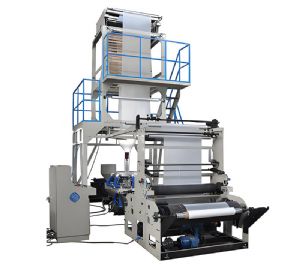
Blown Film Machine
Key packaging film structures: – 3-layer: sealant/core/outer (e.g., mLLDPE/LDPE/LDPE). – 5-layer: sealant/tie/EVOH/tie/outer (barrier). – 7-layer: sealant/tie/EVOH/tie/PA/tie/outer (high barrier). – Materials: mLLDPE (sealant), LDPE (core), HDPE (stiffness), EVOH (oxygen barrier), PA (puncture), PP (heat resistance). Key process parameters: – Melt temperature: 180-240°C depending on layer. – BUR: 2.5-3.5. – Line speed: 80-200 m/min. – Frost line height: 400-600 mm. – Cooling: air ring + IBC. – Thickness: 20-150 µm. Quality control: – OTR, WVTR measurement. – Seal strength, hot tack. – Tensile, tear, puncture. – Haze, gloss. – Layer ratio verification via NIR. In practice, the packaging line must be validated for food contact compliance. Regular cleaning and maintenance of the die and feed block are essential. In conclusion, packaging film extrusion lines are the backbone of the flexible packaging industry, delivering high-performance films for diverse applications.
