Advanced PP Blown Film Equipment: Processing Polypropylene for High-Heat Applications 2026
Polypropylene (PP) is a high-melting-point (160-170°C), semi-crystalline polymer used for films requiring heat resistance, stiffness, and moisture barrier. However, PP is more difficult to process in blown film than PE due to its narrow processing window, high melt elasticity, and susceptibility to melt fracture. PP blown film equipment must be specially designed to handle these challenges. The screw is typically a barrier type with a high compression ratio (3.5-4.5:1) to ensure complete melting of the high melting point PP. The barrel temperature profile is set at 190-230°C, with the metering zone at the higher end. The die temperature must be uniform at 210-240°C. The BUR is limited to 2.0-2.8 because higher BUR causes instability and excessive orientation. The cooling must be rapid but not excessive; a dual-lip air ring with chilled air is often used. The line speed is moderate (50-100 m/min) because PP films are usually thicker (30-100 µm). The melt pump is often used to reduce pressure fluctuations and prevent melt fracture. In summary, PP blown film equipment is a specialized line that requires precise temperature control, a high-compression screw, and careful bubble management. The narrow processing window demands skilled operation. The films produced are used for textile packaging, food wraps (biscuits), and medical packaging where heat resistance is required.
Melt fracture is a common issue in PP extrusion, appearing as surface roughness or sharkskin. It is caused by high shear rates at the die lip. To prevent melt fracture, the die gap should be larger (1.0-1.5 mm) and the melt temperature should be high enough to reduce viscosity, but not too high to cause degradation. The use of a melt pump and a smooth die lip (polished) also helps. The bubble stability is improved by using a bubble cage and precise internal pressure control. The PP resin's melt strength is lower than that of LDPE, so the BUR must be kept low. The frost line height should be low (300-500 mm) to stabilize the bubble. The film's optical properties (clarity, gloss) are excellent if cooling is uniform. In practice, the operator must monitor the bubble shape closely; any oscillation indicates instability. The use of IBC can help by providing internal support. In summary, PP blown film production requires careful optimization of temperature, screw speed, and cooling to avoid melt fracture and instability. The equipment must be designed for the specific rheology of PP. In conclusion,
PP blown film equipment is a niche but essential segment, enabling the production of high-heat-resistant films for demanding applications. Its operation demands a high level of expertise and attention to detail.
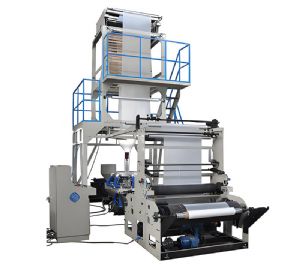
Blown Film Machine
Key PP processing parameters: – Melt temperature: 210-240°C. – BUR: 2.0-2.8. – Frost line height: 300-500 mm. – Line speed: 50-100 m/min. – Die gap: 1.0-1.5 mm. – Cooling: high airflow, often chilled. – Screw compression ratio: 3.5-4.5:1. – Use of melt pump recommended. Common issues: – Melt fracture: increase die gap or temperature; use melt pump. – Bubble instability: lower BUR; increase cooling; use bubble cage. – Degradation: avoid excessive temperature; use nitrogen purge. – Gauge bands: ensure die temperature uniformity. In practice, PP lines often run with stabilizers and nucleating agents to improve clarity and stiffness. The operator must adjust the temperature profile based on the PP grade (homopolymer vs. copolymer). In conclusion, PP blown film equipment is specialized but essential for producing high-performance films for packaging and industrial applications.
