Advanced Orientation and Shrink Control in PP Blown Films 2026
PP blown films are often used in applications requiring controlled shrinkage, such as shrink labels and overwrap. The shrinkage is determined by the molecular orientation frozen in during processing. The MD orientation is controlled by the DDR (draw-down ratio), and the TD orientation by the BUR. For balanced shrink, the product of BUR and DDR should be in a certain range (typically 10-15). For PP, the orientation relaxation is slower than for PE, so the orientation is more "locked in". The shrink performance is tested by immersing the film in hot water or oil at a specific temperature; the percentage of shrinkage in MD and TD is measured. To achieve high shrink, the orientation must be high, but this can reduce mechanical properties. Therefore, the process must be optimized for the target shrink. The cooling rate also affects shrink; faster cooling freezes more orientation, leading to higher shrink. In summary, orientation and shrink control in PP blown films require careful tuning of BUR, DDR, and cooling. The operator must measure shrink regularly and adjust parameters accordingly.
Post-processing annealing can reduce shrink by allowing the oriented chains to relax. The film is passed over heated rollers (annealing) before winding, which reduces the shrink potential. This is used for films that need low shrink (e.g., for lamination). The annealing temperature is typically 100-130°C, below the melting point. The residence time and tension must be controlled to avoid distortion. The annealing can be integrated in-line or offline. In practice, the shrink performance is a key specification; the operator adjusts the process to meet the customer's requirement. In conclusion, orientation and shrink control are critical for PP blown films. By adjusting BUR, DDR, and annealing, converters can produce films with tailored shrink properties for various applications.
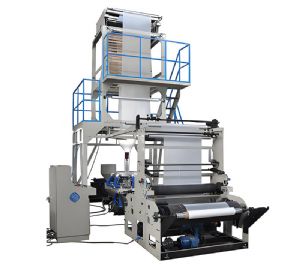
Blown Film Machine
Key shrink parameters: – BUR: higher BUR increases TD shrink. – DDR: higher DDR increases MD shrink. – Cooling rate: faster cooling increases shrink. – Annealing: reduces shrink. – Test method: hot water at 90-100°C, measure % shrink. Typical shrink values: – Balanced shrink: 30-50% each direction. – MD dominant: 50-60% MD, 20-30% TD. – TD dominant: 20-30% MD, 50-60% TD. Control strategies: – Adjust BUR and DDR to achieve target shrink balance. – Use faster cooling to increase shrink. – Use annealing to reduce shrink. – For low shrink, use lower BUR and DDR, and anneal. In practice, shrink is often a key quality parameter; the operator must monitor it regularly. In conclusion,
PP blown film equipment must be capable of precise orientation control to produce films with the desired shrink properties for the packaging industry.
