Advanced Optimization of Blow-Up Ratio for Balanced Film Properties and Bubble Stability 2026
The blow-up ratio (BUR) is a primary process parameter that dictates the transverse direction (TD) orientation and, together with the draw-down ratio (DDR), determines the film's mechanical and optical properties. The BUR is defined as the ratio of the bubble diameter to the die diameter. The optimization of BUR is a trade-off: increasing BUR enhances TD tear strength, impact resistance, and puncture resistance, but also increases haze, reduces clarity, and can cause bubble instability if too high. Conversely, decreasing BUR improves clarity and stability but reduces mechanical strength. The optimal BUR for a given application is typically found in the range of 2.0 to 4.0. For high-clarity packaging films, a BUR of 2.0-2.5 is common, while for high-strength films (e.g., shrink, agricultural), a BUR of 3.0-4.0 is preferred. The BUR also affects the film's lay-flat width; for a given die diameter, higher BUR gives wider film. The BUR interacts with the DDR (the ratio of haul-off speed to melt exit speed) to determine the balanced orientation. A balanced film (MD ≈ TD properties) is achieved when the product of BUR and DDR is approximately 10-15. For example, BUR=3.0 and DDR=4.0 gives a product of 12, which is balanced. If the product is too high, MD orientation dominates; if too low, TD dominates. Therefore, optimizing BUR requires simultaneous adjustment of DDR. The BUR is controlled by the internal air pressure; increasing pressure inflates the bubble, raising BUR. However, the internal pressure must be balanced with the external cooling air to maintain a stable frost line. In summary, BUR optimization is a central task in blown film process development. It requires a systematic approach, often using DOE, to find the combination of BUR and DDR that yields the target properties while maintaining bubble stability.
The effect of BUR on bubble stability can be analyzed through the concept of the bubble's "natural frequency." A bubble with high BUR (≥4.0) has a thinner wall and larger surface area, making it more susceptible to oscillations caused by air currents or pressure fluctuations. The stability can be improved by using a dual-lip air ring with precise airflow control, and by adding IBC, which provides additional pneumatic support. The frost line height also affects stability; a lower frost line (faster cooling) tends to stabilize the bubble because the frozen section provides structural support earlier. Therefore, when increasing BUR, the cooling system must be adjusted to maintain a low frost line. The BUR also affects the gauge profile; high BUR amplifies any die gap or cooling non-uniformity, leading to larger gauge bands. Therefore, a high BUR line requires a very uniform die and air ring. In practice, operators often set a BUR that is as high as possible without causing instability, to maximize strength. The use of process simulation tools can help predict the optimal BUR for a given resin and die design, reducing the need for extensive experimentation. In summary, BUR optimization is a balance of property enhancement and process stability. The maximum BUR is limited by the cooling system and the resin's melt strength. By carefully tuning the air ring, IBC, and temperature profile, operators can push BUR to the upper limit of the stable range, achieving superior film properties. In conclusion, BUR is a powerful lever for tailoring film performance. Its optimization requires a deep understanding of the relationship between process parameters and film properties, as well as the ability to maintain stability at higher BUR. With the right equipment and expertise, converters can achieve films with exceptional strength and clarity for demanding applications.
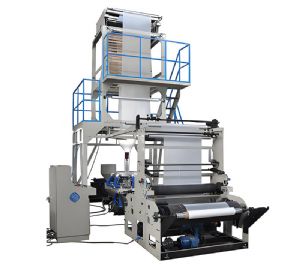
Blown Film Machine
Key relationships: – BUR ↑ → TD strength ↑, clarity ↓, haze ↑, stability ↓. – BUR ↓ → clarity ↑, stability ↑, strength ↓. – Balanced orientation: BUR × DDR ≈ 10-15. – For a given die diameter, lay-flat width = π × Die Diameter × BUR / 2. – Higher BUR requires more cooling air to maintain frost line. – Higher BUR amplifies gauge variations. – Maximum BUR depends on resin melt strength and cooling capacity. Optimization steps: 1) Define target film properties (tear, clarity, strength). 2) Choose a starting BUR (e.g., 2.5). 3) Adjust DDR to achieve balanced properties. 4) Measure film properties and gauge. 5) Incrementally increase BUR while monitoring stability and properties. 6) At the point where instability appears, reduce slightly. 7) Verify properties meet specs. 8) Document optimal BUR and settings. In conclusion, BUR optimization is a critical process development activity. It requires patience, careful measurement, and the ability to interpret data. With a systematic approach, converters can find the BUR that maximizes film performance while maintaining stable production.
