Advanced Optical and Mechanical Synergy in Micro-layer Blown Films 2026
Micro-layer films exhibit unique optical properties due to the interference of light reflected from the numerous interfaces. When the layer thicknesses are in the range of visible light wavelengths (400-700 nm), constructive interference can produce iridescent colors. This is sometimes desired for decorative films, but can be undesirable for packaging where transparency is required. The optical properties can be controlled by adjusting the layer thickness distribution. The mechanical synergy arises from the "brick-and-mortar" effect: the numerous interfaces impede crack propagation, increasing toughness and tear resistance. The reinforcement is anisotropic; it is most effective when the layers are oriented in the direction of stress. The micro-layer structure also improves puncture resistance. In summary, the optical and mechanical synergies are unique features of micro-layer films. They can be tailored by controlling the layer structure and orientation. The design of the layer sequence and thicknesses is critical for achieving the desired properties. Computational modeling is often used to predict the optical and mechanical performance.
The optimization of layer number and thickness distribution involves a trade-off. Increasing the number of layers enhances barrier and mechanical properties but increases the complexity and cost. The optimal layer count is typically between 27 and 81 for most applications. The layer thicknesses can be varied across the stack to create a gradient effect. The use of different polymers in alternating layers can create a synergistic effect: e.g., a hard polymer (PP) alternating with a tough polymer (PE) can produce a film that is both stiff and tough. The interfacial adhesion must be sufficient to prevent delamination; tie layers may be used. In practice, the micro-layer line must be capable of producing a precise layer thickness profile. The NIR gauge with high resolution is essential. The operator must monitor the film properties and adjust the process to achieve the target. In conclusion, the optical and mechanical synergies in micro-layer films make them attractive for high-performance applications. The ability to tailor properties through layer design offers a new dimension in film engineering.
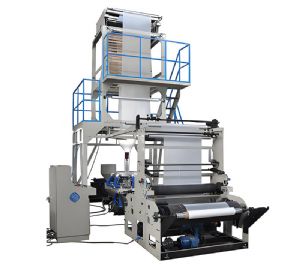
Blown Film Machine
Key optical effects: – Iridescence: when layer thickness ~400-700 nm. – Transparency: achievable with thinner layers (<100 nm). – Gloss: enhanced by smooth interfaces. – Haze: can be reduced by minimizing thickness variation. Key mechanical effects: – Tear strength: increased by up to 2-3 times. – Impact resistance: significantly improved. – Stiffness: can be tuned by polymer selection. – Puncture resistance: enhanced. Design considerations: – Layer number: 27-81 for most applications. – Thickness distribution: uniform or gradient. – Polymer selection: complementary properties. – Tie layers: if needed for adhesion. – Orientation: affects mechanical properties. In practice, the micro-layer film is often customized for specific customer requirements. The line must be flexible enough to produce different layer structures. In conclusion, micro-layer technology offers a powerful way to create films with tailored optical and mechanical properties, opening new opportunities in packaging and industrial applications.
