Advanced Neck-In and Edge Control for Maintaining Consistent Lay-Flat Width 2026
Neck-in is the reduction in bubble diameter that occurs as the film is pulled upward and cooled, due to the tension from the haul-off. The neck-in effect causes the bubble to narrow slightly between the die exit and the frost line, resulting in a lay-flat width that is smaller than the theoretical value based on the die diameter and BUR. The neck-in is influenced by the melt strength, the haul-off tension, and the cooling rate. A high neck-in can cause the lay-flat width to be 5-10% less than expected, and it can vary with line speed or cooling changes. To compensate for neck-in, the BUR (internal pressure) must be adjusted to achieve the target lay-flat. The neck-in also affects the edge thickness; the edges of the bubble are typically thinner than the center due to the neck-in, which requires edge trimming. Therefore, controlling neck-in is essential for maintaining consistent lay-flat width and minimizing edge trim waste. The neck-in can be reduced by increasing the internal pressure (higher BUR), but this also increases TD orientation. Alternatively, reducing haul-off tension (lower speed) can reduce neck-in, but that reduces output. The use of a bubble cage or stabilizing rings can help stabilize the bubble and reduce neck-in by providing mechanical support. In summary, neck-in is an inherent part of the blown film process, but it can be managed through careful control of BUR and haul-off tension. The operator must monitor the lay-flat width and adjust accordingly. Regular measurement of the edge thickness can indicate neck-in severity; if the edges are consistently thin, the BUR may need adjustment.
Edge control involves maintaining the edges of the bubble flat and uniform, which affects the edge trim waste and the width consistency. The collapsing frame's angle and the nip roll alignment are critical for edge control. If the collapsing frame is not symmetrical, the bubble will tilt, causing one edge to be longer. The nip roll pressure must be even to prevent edge wrinkling. The use of edge guides on the collapsing frame can help center the bubble. The lay-flat width measurement sensor must be positioned correctly to capture the full width. In practice, operators adjust the collapsing frame and nip roll pressure to achieve a flat, wrinkle-free tube. The lay-flat width control system then maintains the target width by adjusting internal pressure. If the neck-in changes (e.g., due to resin change), the width setpoint may need adjustment. In summary, edge control and neck-in management are closely related to lay-flat width control. By optimizing the collapsing frame and nip roll settings, and by compensating for neck-in with internal pressure adjustments, converters can achieve consistent lay-flat width with minimal edge trim. In conclusion, neck-in and edge control are advanced aspects of lay-flat width management. They require attention to both mechanical setup and process control to maintain product consistency and reduce waste.
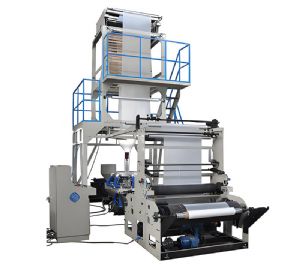
Blown Film Machine
Key factors influencing neck-in: – Melt strength: higher strength reduces neck-in. – Haul-off tension: higher tension increases neck-in. – Cooling rate: faster cooling increases neck-in (freezes orientation). – BUR: higher BUR reduces neck-in (larger bubble). – Line speed: higher speed increases neck-in. – Resin type: LLDPE has higher melt strength than LDPE, reducing neck-in. Control strategies: – Increase BUR to compensate for neck-in. – Reduce haul-off speed if neck-in is excessive. – Use bubble cage to stabilize. – Adjust collapsing frame angle. – Monitor edge thickness and adjust. – Use automatic width control with feedforward from speed. In practice, a well-tuned lay-flat control system can maintain width within ±3 mm even with varying neck-in. This reduces edge trim and improves bag quality. In conclusion, understanding and managing neck-in is essential for efficient tubular film production.
