Advanced NIR Gauge and Layer-Specific AGC for Multi-Layer Co-extrusion 2026
In multi-layer co-extrusion, controlling the overall thickness is not enough; each layer's thickness must be individually controlled to achieve the desired functional properties (e.g., barrier, seal). Near-Infrared (NIR) spectroscopy is the most common online technique for layer-specific thickness measurement. NIR gauges use multiple wavelengths that are absorbed differently by different polymers (e.g., PE, PA, EVOH). By analyzing the absorption spectrum, the gauge can determine the thickness of each layer. The NIR gauge is typically installed after the nip rolls, scanning across the width. The measurement accuracy depends on the calibration models, which must be developed for each resin type and layer structure. The calibration requires samples with known layer thicknesses, measured offline. The NIR gauge provides a profile of each layer's thickness, which is used by the AGC to adjust the individual extruder outputs (screw speeds) or the die gap (for overall thickness). The layer ratio control is crucial: if one layer deviates, the AGC adjusts that extruder's speed while maintaining the total output. In summary, NIR-based AGC enables precise control of each layer's thickness, ensuring that the film meets the required functional specifications. The calibration and maintenance of the NIR gauge are critical for accuracy. In conclusion, advanced NIR gauging and layer-specific AGC are essential for high-quality multi-layer film production.
The NIR gauge must be calibrated for each product; the calibration model should account for temperature and moisture effects. The gauge's scanning speed must be fast enough to capture width-wise variations. The AGC algorithm for multi-layer control must be decoupled: changing one extruder's speed affects the total thickness, so the other extruder speeds must be adjusted to maintain the total. This is a multi-variable control problem; the algorithm should use a decoupling matrix. In practice, the operator should monitor the layer profiles and adjust the AGC if needed. The NIR gauge should be cleaned regularly and its calibration verified with reference samples. In conclusion, advanced NIR gauging and layer-specific AGC provide the control needed for consistent, high-performance multi-layer films.
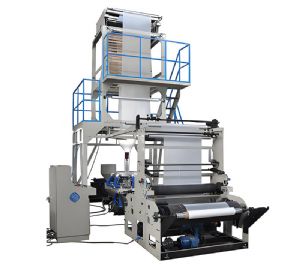
Blown Film Machine
NIR gauge features: Measures layer thickness via absorption spectra. Calibration: requires samples for each layer structure. Accuracy: ±0.5-1% of layer thickness. Scan speed: must match line speed. Compensation: temperature and moisture. AGC for multi-layer: Decoupling control to avoid interactions. Each layer's extruder speed adjusted individually. Total thickness maintained by die gap or master speed. In practice, the operator should work with the gauge supplier to develop robust calibration models. In conclusion, advanced NIR gauging and layer-specific AGC are essential for high-quality multi-layer films, enabling precise layer thickness control and material efficiency.
