Advanced Multi-layer Co-extrusion Blown Film Line: Interfacial Stability and Layer Ratio Control 2026
A multi-layer co-extrusion blown film line is a sophisticated system that combines two or more polymer melts from separate extruders into a single film with distinct layers, each providing specific functionality. The number of extruders equals the number of layers, and each extruder is equipped with its own screw, barrel, heating zones, and feeding system. The layer configuration is determined by the required film properties: for example, a sealant layer (inner), a barrier layer (EVOH or PA), and a structural outer layer. The key challenge in multi-layer co-extrusion is achieving stable interfaces between the layers, which requires matching the rheological properties (viscosity and elasticity) of the adjacent polymers. When the viscosity ratio (η_1/η_2) deviates significantly from 1, interfacial waves can develop, leading to layer breakup or delamination. The elasticity ratio also plays a role; high elasticity mismatch can cause viscoelastic instability. To mitigate these issues, tie layers (e.g., maleic anhydride grafted PE) are used between incompatible polymers, providing a gradual transition in rheology. The die design is critical; feed block dies combine the layers before the die, while multi-manifold dies keep the layers separate until near the die exit, allowing independent temperature control and better stability for high layer counts. In summary, the design and operation of a multi-layer line require a deep understanding of polymer rheology and careful matching of layer viscosities. The use of tie layers, precise temperature control, and advanced die designs are essential for producing defect-free multi-layer films with consistent layer ratios.
The layer ratio (the percentage of total thickness contributed by each layer) must be controlled precisely, as it directly affects the film's functional properties. For example, the barrier layer thickness determines the oxygen transmission rate (OTR). The layer ratio is controlled by the relative output of each extruder, which is set by the screw speed and, if used, the melt pump speed. Gravimetric feeders provide accurate feed rate control, and closed-loop control based on NIR layer thickness measurement can correct any deviations. The feed block or die must distribute each layer uniformly around the circumference; any asymmetry causes gauge bands. The die's heating system must maintain a uniform temperature to prevent viscosity variations. The layer ratio accuracy is typically within ±1-2% for well-tuned systems. In practice, operators monitor the layer thickness profile using NIR gauges and adjust the extruder speeds accordingly. The changeover from one layer structure to another involves purging the extruders and resetting the feed block, which can take several hours. Therefore, multi-layer lines are usually dedicated to a limited number of products to maximize efficiency. In summary, precise layer ratio control is essential for meeting product specifications. It requires accurate feeding, stable process conditions, and regular calibration. The investment in advanced control systems (NIR gauges, melt pumps) is justified by the reduction in scrap and the ability to produce high-value films. In conclusion, multi-layer co-extrusion is a powerful technology that enables the production of films with tailored properties. The success of a multi-layer line depends on the careful design of the layer structure, the selection of compatible resins, and the precise control of layer ratios and interfacial stability. With proper engineering and operation, these lines can produce films with exceptional barrier, seal, and mechanical properties for demanding packaging applications.
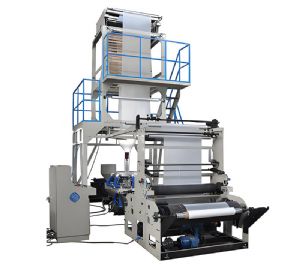
Blown Film Machine
Key interfacial stability criteria: – Viscosity ratio η_1/η_2 between 0.5 and 2.0 for stable flow. – Elasticity ratio (first normal stress difference) matched as closely as possible. – Use tie layers to bridge incompatible polymers. – Maintain uniform die temperature to avoid viscosity variations. – Keep layer thicknesses above a minimum (typically >5% of total) to avoid breakup. – Use multi-manifold dies for high layer counts (≥5) to allow independent temperature control. – Optimize feed block geometry using CFD to minimize stagnation and flow imbalance. Key layer ratio control parameters: – Extruder screw speeds and melt pump speeds. – Gravimetric feeder accuracy: ±0.5% or better. – NIR gauge for layer-specific thickness measurement. – Closed-loop control adjusting individual extruder outputs. – Recipe management for automatic changeover. – Regular calibration of feeders and gauges. In practice, the operator must also monitor the melt pressure and temperature of each extruder; any deviation indicates a feeding or melting issue. The die's pressure drop should be stable; fluctuations indicate a problem with the feed block or die. Regular cleaning of the feed block and die is essential to prevent polymer degradation and build-up, which can cause die lines and interfacial defects. In conclusion, multi-layer co-extrusion is a complex but highly rewarding technology that allows converters to produce films with unprecedented performance. By mastering interfacial stability and layer ratio control, converters can offer differentiated products with high margins.
