Advanced Micro-layer Blown Film System: Nanoscale Layer Multiplication and Property Enhancement 2026
A micro-layer blown film system is an advanced co-extrusion technology that produces films with dozens to hundreds of alternating micro-layers, each being a few microns or even sub-microns thick. This is achieved by using a layer multiplication module that splits and recombines the melt streams. For example, an initial 3-layer feed can be multiplied to 9, 27, or 81 layers through a series of "layer multipliers" that divide the flow and stack the layers. The result is a film with a highly laminated structure that significantly enhances mechanical and barrier properties due to the "tortuous path" effect for gas molecules and the impedance of crack propagation by the numerous interfaces. The micro-layer system typically uses 3-5 extruders and a specialized feed block with multiplication elements. The die is a multi-manifold type to handle the complex flow. The line speed is moderate (30-80 m/min) because of the high layer count and the need for precise control. The individual layer thickness can be as low as 10-50 nm, approaching nanoscale, which can create optical effects (iridescence). In summary, the micro-layer system is a cutting-edge technology that pushes the boundaries of film performance. It allows the use of less barrier material to achieve the same barrier performance through the multiplication effect. The investment is high, and the process requires extreme precision, but the resulting films offer superior properties for high-end applications like medical packaging and automotive films.
The barrier improvement in micro-layer films is due to the increased number of interfaces, which create a tortuous path for gas molecules. The oxygen transmission rate (OTR) can be reduced by 50% or more compared to a conventional 3-layer film with the same total barrier material thickness. The mechanical properties are also enhanced: the numerous interfaces impede crack propagation, increasing tear strength and impact resistance. The layer thickness distribution must be extremely uniform; any variation causes defects. The rheological matching of adjacent layers is critical; mismatched viscosities cause layer breakup. The die and feed block must be designed to handle the high layer count without stagnation. The control system must monitor the layer thickness profile (using NIR or Raman spectroscopy) and adjust the extruder speeds accordingly. In practice, micro-layer lines are often custom-built for specific products. The operator must be highly trained to manage the complex process. The changeover time is long, so the line is dedicated to a limited product range. In summary, the micro-layer system is a revolutionary technology that offers significant performance advantages. Its successful operation requires state-of-the-art equipment, precise control, and skilled personnel. The benefits in material savings and performance justify the investment for premium markets. In conclusion, the micro-layer blown film system represents the forefront of blown film innovation, enabling films with properties that were previously impossible. As the technology matures, it is expected to find broader applications in sustainable packaging by reducing material usage while maintaining performance.
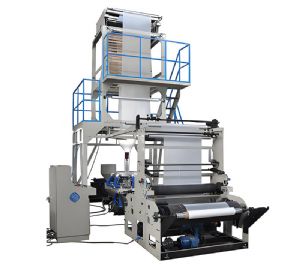
Blown Film Machine
Key principles of layer multiplication: – Splitting a melt stream into multiple streams and recombining them. – Each multiplication doubles or triples the number of layers. – Initial feed: 3-layer -> after one multiply: 9 layers -> after two: 27 -> after three: 81. – The final layer thickness is determined by the initial layer thickness divided by the multiplication factor. – The process requires precise temperature and pressure control to prevent layer merging. Benefits: – Barrier enhancement: OTR reduced by 50%+ with same total barrier. – Mechanical synergy: tear and impact resistance improved. – Optical effects: iridescence from nanolayers. – Material savings: less barrier resin needed. Challenges: – Rheological matching: adjacent layers must have similar viscosity. – Layer uniformity: any variation causes defects. – Die design: must handle complex flow without stagnation. – Control: high precision required. – Cost: high investment and maintenance. In practice, micro-layer lines are used for high-value products where performance is paramount. The technology is still evolving, with research focusing on new materials and multiplication methods. In conclusion, micro-layer systems offer a path to superior film performance and sustainability, making them a strategic technology for the future of blown film.
