Advanced Melt Temperature Control Strategies for Viscosity Stability and Bubble Integrity 2026
Melt temperature is one of the most critical process parameters in blown film, as it directly affects melt viscosity, which in turn influences pressure, flow rate, and bubble stability. Variations in melt temperature cause changes in viscosity, leading to thickness variations and bubble instability. The target melt temperature is typically set based on the resin's recommended processing range, with a margin to avoid degradation. The extruder's barrel is divided into multiple heating zones (typically 4-6), each with a PID controller that maintains the setpoint. The temperature profile along the barrel is usually a rising gradient: the feed zone is cooler (to prevent bridging), the compression zone is hotter (to melt), and the metering zone is slightly cooler (to homogenize). The die is also heated, often with multiple zones to ensure uniform temperature around the circumference. The melt temperature is measured at the adapter or before the die using a thermocouple. However, the thermocouple measures only the wall temperature; the bulk melt temperature may be higher by 5-10°C due to shear heating. Therefore, some lines use an infrared sensor to measure the melt core temperature. To control melt temperature, the barrel cooling system (air or water) is used to remove excess heat, especially when shear heating from high screw speeds raises the temperature. The cooling must be balanced with the heating to maintain stable temperature without overshoot. In summary, melt temperature control is a delicate balancing act between heat input (from heaters and shear) and heat removal (through barrel cooling). Advanced PID controllers with auto-tuning can maintain temperatures within ±1°C, but they must be periodically recalibrated to account for changes in ambient conditions or screw wear. The melt temperature should be monitored continuously; any deviation beyond ±2°C should trigger an alarm.
The homogeneity of melt temperature across the flow is also critical. Temperature gradients within the melt cause non-uniform viscosity, leading to gauge bands and die lines. To promote temperature homogeneity, the screw's mixing section (e.g., Maddock or pineapple) is used to redistribute the melt and equalize temperature. The melt pump also helps by inducing turbulent flow, which mixes the melt. The die's manifold design must distribute the melt with minimal temperature variation; the die's heating zones must be tuned to compensate for heat loss at the edges. The use of thermal insulation on the barrel and die reduces heat loss and improves stability. In practice, operators monitor the temperature of each zone and the melt pressure. A rise in melt pressure at constant temperature indicates a viscosity increase, which may be due to a change in resin or a screen clog. Conversely, a pressure drop indicates a viscosity decrease, possibly due to degradation. Therefore, melt temperature control is integrated with pressure control in the line's PLC. In summary, achieving melt temperature homogeneity requires a combination of good screw design, precise temperature control, and proper insulation. Regular maintenance of heater bands and thermocouples is essential to maintain accuracy. In conclusion, melt temperature control is a fundamental aspect of blown film extrusion. By maintaining a stable, homogeneous melt temperature, converters can ensure consistent viscosity, stable bubble formation, and uniform film thickness, leading to high-quality products and reduced scrap.
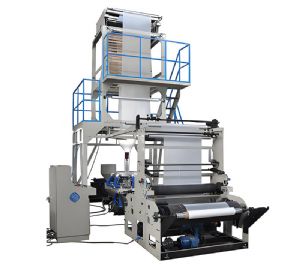
Blown Film Machine
Key parameters and their effects: – Barrel zone temperatures: set to resin's recommended profile. – Screw speed: higher speed increases shear heating. – Cooling water flow: adjust to control barrel temperature. – Die temperature: should be near melt temperature; higher reduces viscosity but may degrade. – Melt pressure: indicator of viscosity; stable pressure indicates stable temperature. – Ambient temperature: affects cooling efficiency; seasonal adjustments may be needed. Tuning PID controllers: – Use auto-tuning function to find optimal gains. – Manual tuning: adjust proportional gain to reduce overshoot, integral to eliminate offset, derivative to dampen oscillations. – For slow processes (like barrel heating), derivative is often set low. – For die zones, faster response is needed; increase derivative. Maintenance: – Check heater band resistance regularly; replace if off-spec. – Calibrate thermocouples with a standard. – Clean cooling water passages to maintain flow. – Inspect insulation for damage. In conclusion, melt temperature control is a continuous process that requires attention to detail. With proper equipment and regular maintenance, converters can achieve the temperature stability needed for consistent, high-quality film production. Advanced control strategies, such as model predictive control, are also being adopted to further improve performance.
