Advanced Measurement and Modeling of Frost Line Height for Process Optimization 2026
Accurate measurement of frost line height (FLH) is essential for process control. Traditional methods involve visual observation using a scale or a laser pointer, which is subjective and not suitable for automation. Advanced methods include thermal imaging and machine vision. Thermal imaging cameras detect the temperature profile of the bubble; the frost line is the isotherm corresponding to the crystallization temperature. By analyzing the thermal image, the FLH can be determined precisely and continuously. Machine vision systems use a CCD camera and image processing algorithms to detect the change in film appearance (glossy to matte) and calculate the height. These systems can provide real-time FLH data to the control system, enabling automatic adjustment. The measurement accuracy is typically within ±5 mm. The FLH data can also be used for process monitoring and troubleshooting; a sudden change in FLH indicates a disturbance in cooling or melt temperature. In summary, advanced FLH measurement systems are key enablers for automated process control. They provide objective, continuous data that can be used for feedback control, alarm generation, and data logging. The investment in such systems is justified by the improvement in consistency and reduction in scrap.
Mathematical modeling of FLH can predict the frost line position based on process parameters. The model uses the energy balance: the heat to be removed from the melt equals the convective heat transfer from the bubble surface. The heat transfer coefficient depends on air flow velocity and temperature. The model inputs include melt temperature, output, bubble diameter, cooling air flow, air temperature, and film thickness. The model outputs the FLH and the temperature profile along the bubble. This model can be used to simulate the effect of changes in parameters on FLH, aiding in process optimization. For example, the model can predict how much increase in cooling air flow is needed to lower the FLH by 50 mm. The model can be integrated into the control system as a "soft sensor" that provides a FLH estimate when the vision system is not available. The model can also be used for operator training, helping them understand the interactions. In summary, modeling is a powerful complement to measurement. It provides predictive capability and a deeper understanding of the process. By combining measurement and modeling, converters can achieve precise FLH control and optimize their processes for different products. In conclusion, advanced measurement and modeling of FLH are at the forefront of blown film process technology. They enable a level of control that was previously impossible, leading to higher quality and efficiency. As these tools become more accessible and affordable, they will become standard in modern blown film lines.
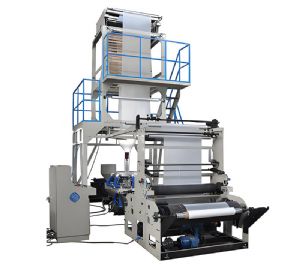
Blown Film Machine
Measurement technologies: – Thermal imaging: provides temperature profile; FLH at crystallization isotherm. – Machine vision: detects appearance change; robust and cost-effective. – Laser triangulation: measures bubble diameter profile; FLH inferred from diameter change. – Ultrasonic sensors: measure thickness profile; FLH from thickness change. Modeling approaches: – Simplified energy balance: Q = h × A × (Tmelt - Tair) – CFD simulations for detailed flow and heat transfer. – Machine learning models trained on historical data. – Hybrid models combining physics and data. Applications: – Real-time control: adjust blower speed to maintain FLH setpoint. – Product changeover: predict optimal cooling settings for new resin. – Troubleshooting: identify cooling non-uniformity. – Process optimization: find FLH that yields best properties. In conclusion, advanced FLH measurement and modeling are powerful tools for blown film production. They enable precise control, reduce scrap, and improve product quality. Converters who adopt these technologies will gain a significant competitive advantage.
