Advanced Measurement and Control of Film Thickness in Multi-Layer Co-extrusion 2026
In multi-layer co-extrusion, the overall film thickness is the sum of the individual layer thicknesses, and each layer must be controlled to achieve the required functional properties (e.g., seal strength, barrier). Measuring individual layer thicknesses is more challenging than measuring overall thickness. Near-infrared (NIR) spectroscopy is the most common online technique for layer-specific measurement. NIR gauges use multiple wavelengths that are absorbed differently by different polymers (e.g., PE, PA, EVOH). By analyzing the absorption spectrum, the gauge can determine the thickness of each layer. The NIR gauge is typically installed after the nip rolls, scanning across the width. The measurement accuracy depends on the calibration models, which must be developed for each resin type and layer structure. The calibration requires samples with known layer thicknesses, measured offline by microscopy or other methods. The NIR gauge provides a profile of each layer's thickness, which is used by the Automatic Gauge Control (AGC) to adjust the individual extruder outputs (screw speeds) or the die gap (for overall thickness). The layer ratio control is crucial: if one layer's thickness deviates, the AGC adjusts that extruder's speed while maintaining the total output. This is a multi-variable control problem, as changing one extruder's speed affects the total thickness, requiring a coordinated adjustment of the others. Advanced control systems use a decoupling algorithm that isolates the effect of each actuator. In summary, NIR-based layer thickness measurement and control enable precise management of multi-layer film properties, ensuring that each layer meets its functional requirement. This is essential for high-performance films where barrier and seal layers must be precisely controlled.
The accuracy of NIR gauging depends on the spectral resolution and the robustness of the calibration model to variations in temperature, moisture, and additives. The gauge must be recalibrated for each product change, or a universal model must be developed. The scanning speed of the NIR gauge must be fast enough to capture width-wise variations, and the control algorithm must compensate for the measurement delay. Some advanced systems use a "predictive" controller that anticipates changes based on process trends, reducing the effect of measurement delay. The control of layer ratios also requires accurate feeding systems (gravimetric feeders) for each extruder, as the NIR gauge provides feedback for correction but cannot compensate for large feed errors. The integration of NIR gauging with the line's PLC and MES allows for automated recipe management and statistical quality control. In practice, operators monitor the layer thickness profiles and may manually adjust the feeders if the AGC cannot maintain the target. The NIR gauge must be regularly cleaned and calibrated to maintain accuracy. In summary, layer thickness measurement and control are key technologies for multi-layer blown film production. They enable the production of complex film structures with consistent properties, meeting the stringent requirements of food, medical, and industrial packaging. The investment in NIR gauging and advanced control is justified by the material savings (using less expensive barrier resin) and the improved film performance. As multi-layer films become more common, these technologies will become standard.
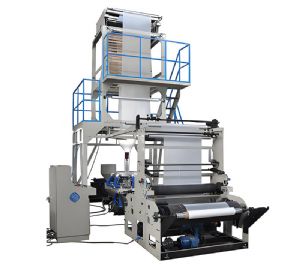
Blown Film Machine
Key aspects of NIR gauge: – Measures absorption at specific wavelengths for each polymer. – Requires calibration with known samples. – Provides profiles of individual layers. – Scan speed affects resolution. – Sensitive to temperature and moisture; must compensate. Control strategies: – Use AGC to adjust total thickness via die gap. – Use individual extruder speed control to adjust layer ratios. – Implement decoupling control to avoid interactions. – Use predictive control to compensate for measurement delay. – Integrate with gravimetric feeders for feedforward control. – Monitor layer ratios with SPC charts. Maintenance: – Clean optical windows regularly. – Recalibrate after any change in resin or additive. – Verify with offline measurements periodically. In conclusion, advanced thickness measurement and control are essential for producing high-quality multi-layer films. They allow converters to achieve the precise layer structures required for modern packaging applications, reducing material cost and ensuring consistent performance. The combination of NIR gauging and advanced control algorithms provides a powerful tool for process optimization.
